
Pickleball paddle spin durability (2026): which long-lasting textures are real, with the data
By My Pickleball Connect Team 14 min read Last reviewed
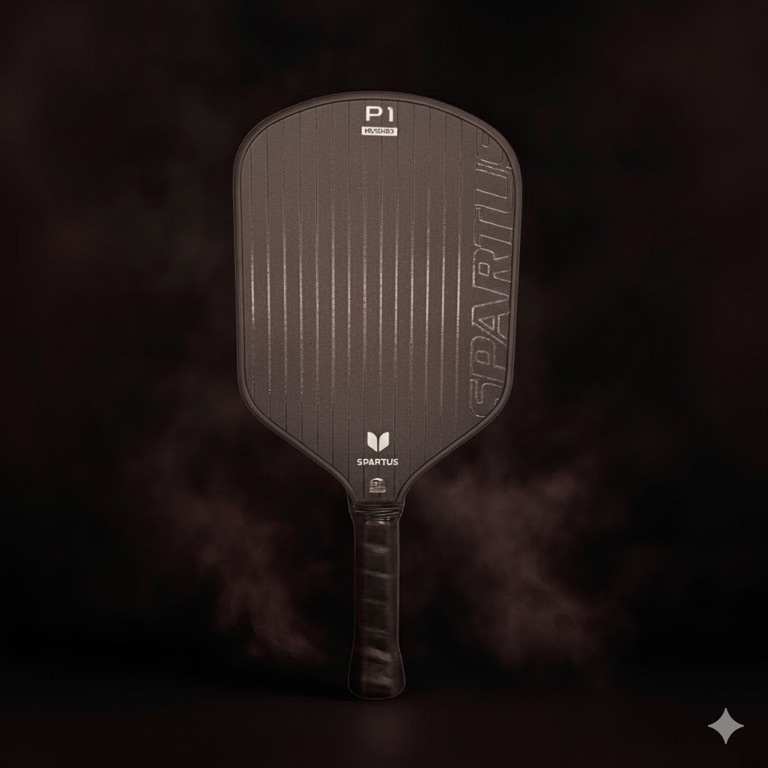
Texture longevity is the single biggest unsolved problem in pickleball gear. Raw carbon fiber faces have been the standard since 2022, and they all degrade. The exact rate varies, but the pattern is consistent: paddles lose 13 to 20% of their RPM output within 100 games, sometimes more. For a player who plays 3 to 5 sessions a week, that's a 1 to 2 month half-life on the spin output that the brand sold them on.
2025 and 2026 brought four named technologies that claim to fix this. Two of them now have measured third-party data behind them. Two are still in the early-claims-without-numbers stage. This page lays out what's verifiable, what isn't, and what the data actually says.
For the underlying methodology that produced these numbers, Pickleball Studio's Spartus P1 Hybrid review is the deepest write-up. The short version: every game is logged individually, every drilling session counted, and surface-roughness plus RPM tests are rerun periodically across the testing window. The protocol is one researcher with one paddle each, so sample sizes are small. Treat the numbers as directional, not as a peer-reviewed study, until more sources start running comparable measurements.
The data table
Every measurement below comes from Pickleball Studio's logged-games protocol, with each entry linking to the underlying review.
| Texture | Paddle tested | Games logged | Starting RPM | After | Drop |
|---|---|---|---|---|---|
| Permagrit | Spartus P1 Hybrid | 84 | 2,044 | 2,017 | ~1.3% |
| HexGrit | 11six24 Vapor Power2 | 100 | 2,141 | 2,071 | ~3.3% |
| Raw carbon fiber | Franklin C45 | 100 | 2,078 | 1,791 | ~13.8% |
| Raw carbon fiber | Bread & Butter Loco | 100 | 2,048 | 1,697 | ~17.1% |
| Diamond Tough | Six Zero Black Opal | No comparable data published | - | - | TBD |
| Florek (long-life claim) | Selkirk LUXX Control Air | No third-party logged-game testing | - | - | TBD |
The headline takeaway: Permagrit and HexGrit are both materially better than raw carbon fiber over comparable testing windows. Permagrit shows a smaller drop, but the Spartus P1 had 84 games logged at time of writing vs 100 on the HexGrit and the raw carbon paddles, so the gap could shrink with more samples. Both technologies are legitimately doing what their marketing says, which is rare.
The four named long-lasting-texture technologies
Permagrit (Spartus)
Permagrit is described as a ceramic-hybrid material applied to the paddle face stateside (which is why Spartus P1 paddles can carry "assembled in the US" labels). Per Pickleball Studio:
"Spartus has said that the Permagrit is applied here in the states, and not in China, which is why the paddles are able to say assembled in the US on them. Lastly, they have stated that the grit is made up of ceramic hybrid materials."
Spartus has also publicly mentioned focusing on friction (not just surface roughness) as a spin variable. Friction is the less-discussed half of the spin equation; most paddles compete on roughness alone. The full breakdown is in our Spartus P1 Hybrid review. Certification: USAP-approved. Tournament-legal everywhere.
HexGrit (11six24)
HexGrit is a proprietary applied texture with a hexagonal pattern. The honest caveat: HexGrit is too rough to pass USAP's certification roughness test, so the 11six24 Vapor Power2 is UPA-A certified only. Per Pickleball Studio:
"USAP currently passes or fails paddles based on a roughness test of the surface, and UPA-A certifies paddles based on RPMs measured by shooting a ball out of a cannon at the paddle, and measuring the actual spin rate from the paddle. So, UPA-A allows you to possibly have a rougher texture than USAP depending on the build of your paddle. In the context of the Power2, it's simply too rough to pass USAP with HexGrit applied to the paddle."
This certification gap matters. UPA-A is the PPA Tour pro-division standard. USAP is what most local tournaments and the APP Tour follow. Many local tournaments accept either stamp; some are strictly USAP. Verify your tournament rules before buying for tournament play. 11six24 has stated they have no plans to release a USAP-certified version. Full review at /reviews/11six24-vapor-power2/.
Diamond Tough (Six Zero)
Six Zero's Diamond Tough texture infuses industry-grade diamonds into the epoxy that bonds the raw carbon fiber face. Six Zero claims 4x longer-lasting texture. Per Pickleball Studio's Black Opal review, this is "potentially promising" but no comparable durability data has been published yet. Six Zero is selling the claim; the third-party measurement protocol is not yet complete on this paddle.
The honest read: Diamond Tough may turn out to be excellent. We don't know yet. Don't buy a Black Opal expecting Permagrit-grade durability based on the marketing alone. Buy a Black Opal because the on-court performance fits your aggressive style (full review at /reviews/six-zero-black-opal/), and treat the texture longevity as upside.
Florek (Selkirk LUXX line)
Selkirk's Florek carbon face is the long-life claim across the LUXX line, including the Control Air, Power Air, and Inferno variants. Selkirk does not publish independent durability data. No third-party logged-game testing has been published at time of writing. Owner reports anecdotally suggest Florek lasts longer than typical raw carbon fiber, but anecdotes are not data.
Florek's other notable property is its texture pattern, which is relatively gentle on the ball compared to the rougher proprietary surfaces. The LUXX line is built around control, not maximum spin output, so the texture story is a different goal: longevity of consistent feel rather than maximum spin durability. Full review of the Selkirk LUXX Control Air at /reviews/selkirk-luxx-control-air-jack-sock/.
Selkirk Infinigrit (separate from Florek)
Mentioned by Pickleball Studio as another Selkirk long-lasting-texture initiative, primarily applied to certain LUXX variants and Power Air builds. Same caveat: no third-party logged-game testing published. Treat as marketing-claim-only until measurements ship.
The roughness vs friction debate
Worth understanding because it explains why the certification picture is so tangled. There are three variables that drive how much spin a paddle generates:
- Surface roughness: how textured the face actually is, measured by physical roughness instruments. USAP's certification test reads this directly.
- Friction: how much the ball "grabs" the face during contact. This is what Spartus and Proton (the older Nanotac paddle) have said they're optimizing for. Friction matters but isn't directly measured by USAP's current test.
- Deflection (dwell): how long the ball stays on the face. Foam cores and certain face constructions affect this.
Per Pickleball Studio: "Friction, surface roughness, and deflection are all things that play a role in how much spin you can generate, and companies have usually only focused on a couple of those at a time. To my knowledge, there aren't any raw carbon fiber surfaces that have significantly more friction to them than others."
The implication: a paddle could fail USAP's roughness test (like HexGrit on the 11six24) but generate the same or less RPM than a USAP-passing paddle, depending on friction and deflection. UPA-A's RPM-based test would pass it because actual spin output is the metric. USAP's roughness-based test would not. The two governing bodies are testing different things, which is why dual certification is hard to achieve for paddles pushing the durability envelope.
What this means for buyers
If your goal is maximum spin durability with USAP tournament eligibility, the Spartus P1 Hybrid is the only paddle with measured data behind the claim. Pickleball Studio scored it 8/10. It's $219.99, hybrid-only, has a heavy stock swing weight (117), and a few post-launch reports of loose edge guards which Spartus is publicly addressing.
If you're a kitchen-line spin shaper who doesn't need USAP certification (rec play and PPA pro divisions, plus most local mixed-rule tournaments), the 11six24 Vapor Power2 is the second strongest option. Pickleball Studio scored it 8/10 and placed it in their top-5-to-consider-as-main list. $209.99, three shape options, lighter stock weight than the Spartus (111), tunable.
If you're a PaddleTek-style aggressive driver and want the experimental Diamond Tough story, the Six Zero Black Opal is worth a demo through Pickleball Central's 30-day return policy. Don't buy expecting Permagrit-grade durability without data; buy because the on-court fit is right and treat texture longevity as bonus.
If you're already committed to the Selkirk ecosystem and value long-life Florek consistency over maximum spin output, the Selkirk LUXX Control Air remains the control-leaning standard. The texture-longevity story isn't measured but the construction quality is.
If none of those fit, raw carbon fiber paddles are still excellent paddles. The Bread & Butter Loco (9/10) is the highest-scoring foam paddle in our reviews lineup despite using standard raw carbon fiber and losing ~17% RPM by 100 games. The texture decay is real, but for a paddle most rec players cycle out within 12 months anyway, the lifecycle math is fine.
The honest limits of this data
Three things worth being clear about:
Sample size is one paddle per technology. Pickleball Studio is doing the most rigorous third-party testing in the public eye, but it's still one researcher running one paddle each. A second tester might see different numbers. Manufacturing variance within a batch could produce different results paddle-to-paddle.
Environment matters and isn't fully controlled. Olson noted: "Maybe there are certain environments or conditions where it will wear down faster." Outdoor concrete vs indoor wood, hot vs cold, indoor balls vs outdoor balls, drilling sessions vs match play, all produce different wear patterns. The 84-to-100-game numbers are one player's specific mix.
Long-term horizons are still pending. The Permagrit and HexGrit data covers ~84-100 games. We don't have 200-game, 500-game, or one-year-of-play data yet. Both technologies could turn out to wear nonlinearly: stable for the first 100 games and then cliff. Or stable for the first 100 games and then continue holding. We don't know yet.
Treat the table above as the strongest evidence available right now, but not as final word. Update timing: we'll re-publish this page when more measurements ship from Pickleball Studio or other independent sources, with a new lastReviewed date.
Where this fits in our coverage
This page is the texture-longevity slice of our paddle coverage. For the full foam-paddle buyer's tier, see best foam pickleball paddles 2026. For the underlying core-construction physics, see foam vs honeycomb paddles. For the broader paddle-buying framework, see how to choose a pickleball paddle. For the full reviews behind this page, see /reviews/.
References
- Pickleball Studio: Spartus P1 Hybrid Review (8/10) · Primary source for Permagrit testing methodology, RPM measurements, and the logged-game protocol
- Pickleball Studio: 11six24 Vapor Power2 Review (8/10) · HexGrit RPM data, UPA-A vs USAP certification breakdown, Olson top-5-to-consider framing
- Pickleball Studio: Bread & Butter Loco Review (9/10) · Raw carbon fiber control-paddle data point (100 games, 17% RPM drop)
- Pickleball Studio: Six Zero Black Opal Review (5/10) · Diamond Tough texture context and the "potentially promising, needs more testing" framing
- USA Pickleball approved equipment list · USAP certification authority and current paddle approval list
- UPA-A: PPA Tour governing body · UPA-A pro-tour governing body, RPM-based paddle certification
- Spartus P1 Hybrid product page · Direct-to-consumer source for the Permagrit paddle
- 11six24 Vapor Power 2 product page · Direct-to-consumer source for the HexGrit paddle
Frequently asked
Tap a question to expand.

Reader notes on this guide
Sign in with your email to post. We do not run ad networks; comments are moderated for spam and abuse.
Loading comments...
Sign in to add a comment.