
Foam vs honeycomb paddles: what Gen 3 changed and whether to switch
By My Pickleball Connect Team 11 min read Last reviewed
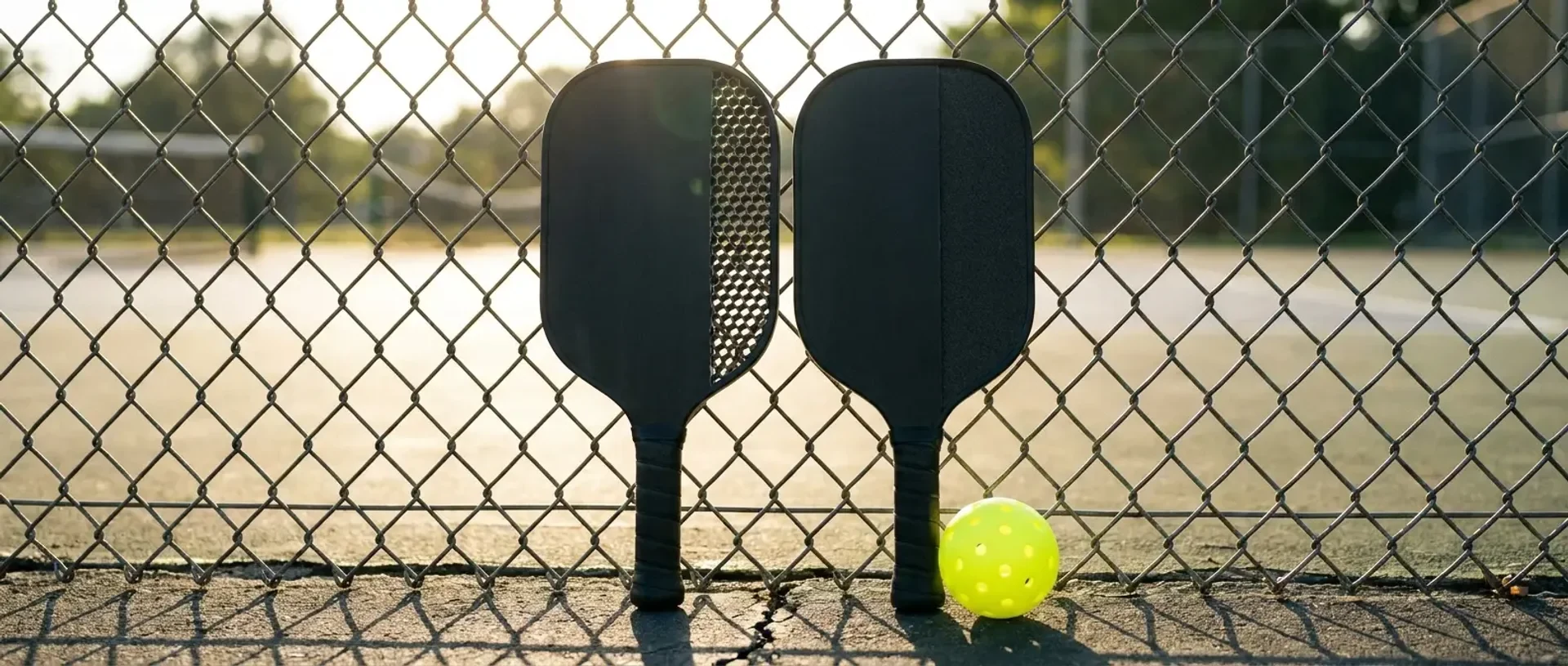
If you walked into a pickleball shop in 2020, almost every paddle on the wall was built the same way. A honeycomb sheet of polypropylene sandwiched between two fiberglass or carbon faces, glued shut, edge guard slapped on. That was Gen 1.
Gen 2 came when brands started thermoforming the whole shell, wrapping the carbon face around the core and creating a sealed unibody that hit harder and lasted longer.
Gen 3 is the wave that broke over the sport in 2024 and is still reshaping the wall today: thermoformed shells with foam injected around the perimeter or layered against the core, designed to harness energy in ways a plain honeycomb never could.
This guide walks through what that actually means on court, what the USAP rulebook says about it, and whether it makes sense for your level.
What Gen 3 actually means
Gen 3 is not a single technology. It is a cluster of construction choices that started showing up together.
The shared ingredients are a thermoformed carbon shell, a polypropylene honeycomb core, and a strip or ring of foam (usually EVA, sometimes TPE or proprietary blends) injected between the core and the edge wall. JOOLA called its version Propulsion Core. Selkirk markets FlexFoam Perimeter on the Power Air line.
ProXR builds a Dual-Foam architecture into its Signature Series. JOOLA's Pro IV adds a separate slug of foam in the throat that the brand calls Tech Flex Power.
The foam does two jobs at once. It adds mass at the perimeter, which raises twist weight and stabilizes off-center hits. It also flexes under load, so the rim of the paddle behaves a little like a diving board: it loads on contact, then springs the ball back. Combine that with a fully encased thermoformed shell and you get a paddle that feels noticeably stiffer in the center and noticeably more forgiving on the edges than a glued-up Gen 1.
The physics: why foam changes feel
Three numbers matter when you compare a Gen 2 honeycomb paddle to a Gen 3 foam-injected one. The first is dwell time, meaning how long the ball stays compressed against the face. Foam compresses further than rigid honeycomb cells before it rebounds, so the ball sits on the face a hair longer. That extra millisecond is what lets a player brush the ball harder for spin without losing it off the paddle.
The second is the sweet spot. A traditional honeycomb has a narrow zone of cells that deform efficiently in the middle of the face. Hits outside that zone twist the paddle and sap the shot. Perimeter foam expands the effective zone because the rim itself becomes elastic. Off-center balls still load energy into the paddle instead of just rotating it. That is what reviewers mean when they say a Gen 3 paddle feels more forgiving.
The third is energy return, which USAP measures with the PBCoR test (Paddle/Ball Coefficient of Restitution) introduced in late 2024. Foam-augmented paddles tend to return more energy at high impact speeds than plain honeycomb. That is the source of the Gen 3 power reputation, and also the source of every regulatory headache the category has run into.
The actual trade-offs
The marketing copy talks about more power, more spin, more sweet spot. The honest version is messier.
Power and spin do go up. Independent testing consistently shows higher RPM numbers and higher pop ratings on Gen 3 designs than on comparable Gen 2 thermoforms. The 11SIX24 Power 2 has been measured around 94 percent power and 95 percent pop in those labs, and the JOOLA Perseus Pro IV scores near the top of every spin chart.
Control on the soft game is the other side of the ledger. The same elastic rim that springs balls off the face also makes a soft dink want to go a little farther than you intended. Players moving from a 16mm Gen 2 control paddle to a Gen 3 power build often report a transition period of a few weeks where their resets float long and their third-shot drops sit up. Skilled hands adjust. Newer players sometimes never do.
Durability is the second compromise. The community calls it core crushing: under repeated high-speed impact, the polypropylene cells under the carbon face slowly collapse and the foam ring loosens. A crushed core often plays hotter than it did new, which can push a paddle out of legal PBCoR range mid-season. Reports of cracking near the throat and of edge guards lifting on thermoformed builds have followed nearly every Gen 3 brand.
Then there is price. A respectable Gen 1 raw carbon paddle like the Six Zero Quartz lands around $90. The Vatic Pro V-Sol Pro foam build sits at $99.99. Step up to a flagship Gen 3 and you are looking at $250 for the Selkirk Vanguard Power Air Invikta, $279.95 for the JOOLA Perseus Pro IV, and $280 for the CRBN TruFoam Genesis. That is roughly a three-times multiple to chase the technology curve.
USAP approval and the bans
The Gen 3 era opened with a public mess. JOOLA launched its first Gen 3 paddles in April 2024, including the Ben Johns Perseus 3, Hyperion 3, Magnus 3, and Scorpeus 3 lines.
On May 15, 2024, USA Pickleball notified JOOLA that the entire Gen 3 lineup was being removed from the Approved Paddle List. JOOLA acknowledged a paperwork issue from a November 2023 similarity-certification submission, then sent fresh samples to an independent third-party lab. Those samples also failed.
By June 4 the delisting was public, by June 5 JOOLA had opened a refund window for buyers between April 16 and June 15, and by June 12 the company had filed suit against USAP in the District of Maryland.
JOOLA did not get the original Gen 3 line reapproved. Instead the brand engineered a compliant successor: the Mod-TA 15 in August 2024, then the 3S series in September 2024, and eventually the Pro IV line that followed PBCoR rules from the start. The 3S and Pro IV variants are USAP and UPA-A approved.
USAP did not stop with JOOLA. The PBCoR test rolled out in Q4 2024 and went into enforcement on July 1, 2025. Among the paddles delisted under PBCoR were the JOOLA Perseus Mod-TA-15, certain Gearbox Pro Power Elongated builds, and ProKennex Black Ace variants.
The Chorus Fire EX and SX were removed in February 2025 for separate reasons. The lesson for buyers is that the Approved list is not static.
Before any tournament purchase, check equipment.usapickleball.org for the current status and look specifically at the PBCoR sub-list, because a paddle can sit on the master list and still be excluded from sanctioned play.
Top current foam options
JOOLA Perseus Pro IV. Elongated 16.5 by 7.5 inches, available in 14mm and 16mm, average weight around 8.1 ounces, swing weight 113 (14mm) and 118 (16mm). Polypropylene core with dual-layer perimeter foam plus a throat foam slug. USAP and UPA-A approved. Around $279.95.
Selkirk Vanguard Power Air Invikta. Elongated 16.5 by 7.375 inches, 0.5-inch core, average weight 7.9 ounces, hybrid fiberglass and carbon face, FlexFoam Perimeter, edgeless DuraEdge. Selkirk's full lineup is USAPA approved. Around $250.
CRBN TruFoam Genesis. The TFG line is a step beyond Gen 3 because the core is fully foam rather than honeycomb-plus-foam, which the brand and many reviewers categorize as Gen 4. Multiple shapes (TFG1 standard, TFG3 elongated 16.5 by 7.5 inches, TFG4 hybrid), 14mm core typical, around 8.1 ounces. Priced around $280.
JOOLA Hyperion 3S and Magnus 3S. The corrected, post-ban Gen 3 line. UPA-A and USAP approved at launch. Same Propulsion Core architecture, recalibrated PBCoR.
Six Zero Quartz. Notable as a counterexample. Raw T300 carbon face, 15mm polypropylene core, no perimeter foam injection. A Gen 1-style build that sells around $90 and shows up in budget reviews precisely because it skipped the foam route.
Vatic Pro V-Sol Pro. A budget foam paddle. Floating EPP foam core with a full EVA perimeter ring, three shapes (Bloom widebody, V7 elongated, Flash hybrid), 16mm thickness, around $99.99. The closest the foam category currently gets to entry-level pricing.
ProXR Signature Series. Toray T700 carbon face, Gen 3 thermoformed dual-foam build, 16.5 by 7.5 inches, 4-inch grip circumference (one of the slimmest on the market), 13mm or 16mm options.
Should you switch?
3.0 players. Probably not yet. The control penalty on the kitchen line is the biggest barrier to climbing out of 3.0, and a hotter paddle makes it worse. A solid Gen 1 or early Gen 2 raw-carbon paddle in the $80 to $130 range will teach better habits faster.
3.5 players. Worth demoing, not worth committing blind. A 16mm Gen 3 with conservative power numbers (think the JOOLA 3S series in 16mm or a control-leaning Selkirk) gets you a wider sweet spot without overwhelming the soft game. Avoid the highest-pop builds at this level.
4.0 players. This is where the math starts to favor foam. The dink game is dialed in, the resets are real, and the extra power on counters and speed-ups translates to actual points. A 14mm Gen 3 or hybrid foam build is a defensible upgrade.
4.5 and up. Most competitive players at this level are already on Gen 3 or full-foam Gen 4 builds. The question stops being whether to switch and becomes which model fits your style: an elongated foam build for power baseline games, a hybrid shape for hands at the kitchen, a standard shape for pure control with a foam bump.
What is coming next
The category is still moving. Full-foam cores (CRBN TruFoam, several 11SIX24 builds) are pulling the conversation past Gen 3 entirely. PBCoR enforcement is producing a tighter, more conservative ceiling on energy return, which is pushing R&D toward sweet-spot expansion and twist-weight engineering rather than raw power.
Expect more variation in foam density (multi-density rings, foam gradients), more attention to durability standards, and continued movement on the Approved list.
The safest move for a buyer in 2026 is to assume any paddle bought today might be re-tested tomorrow, so the brands with public PBCoR data and a track record of compliant resubmissions are a better bet than the ones still pushing the line.
References
- USA Pickleball Approved Paddle List
- USA Pickleball PBCoR Test Update (Q4 2024) · Paddle/Ball Coefficient of Restitution test rolled into enforcement July 1, 2025
- JOOLA Gen 3 Paddle Recall and Refund Notice (June 2024) · Public refund window for Hyperion 3, Perseus 3, Magnus 3, Scorpeus 3 buyers between April 16 and June 15, 2024
Frequently asked
Tap a question to expand.

Reader notes on this guide
Sign in with your email to post. We do not run ad networks; comments are moderated for spam and abuse.
Loading comments...
Sign in to add a comment.