
How to choose a pickleball paddle (without overpaying)
By My Pickleball Connect Team 8 min read
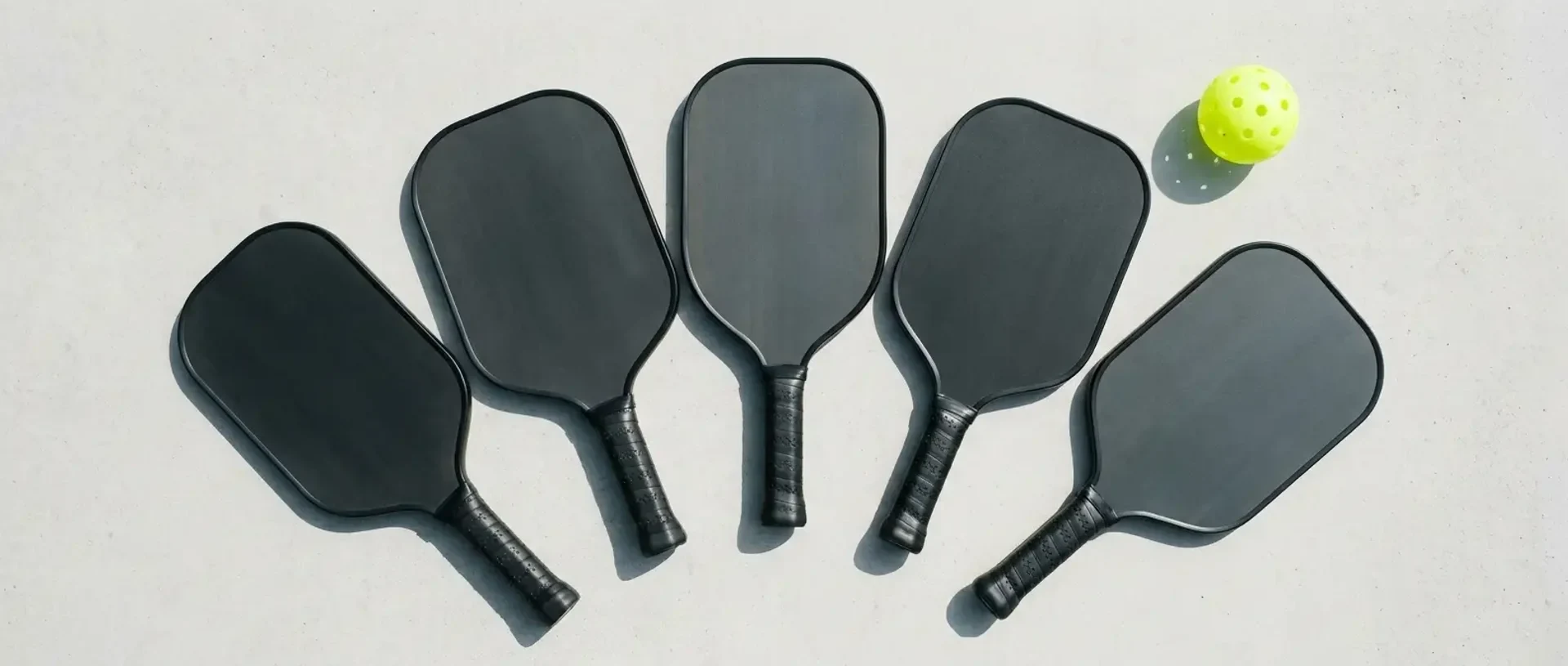
Walk into any pickleball shop and you'll see a wall of paddles that all look pretty similar and cost anywhere from $40 to $300. The honest truth: most players don't need the $280 paddle. They need the right $90 to $150 paddle. Here's how to figure out which one that is without getting talked into features you won't use.
Start with weight
Weight is the single biggest thing that changes how a paddle feels. Most paddles land between 7.3 oz and 8.5 oz. The sweet spot for almost everyone is 7.8 oz to 8.2 oz.
Heavier paddles (8.0 oz and up) give you more power and stability on blocks. They're easier to hit through the ball with, but they wear out your arm and slow your hands at the kitchen. If you've got tennis elbow or any wrist issue, go lighter.
Lighter paddles (under 7.6 oz) are quick. Great for fast hands battles, less great when someone drives a ball at you and you need to block it without the paddle getting pushed back. Beginners sometimes grab a super light paddle thinking it'll be easier to swing. It is. It's also harder to control on anything but a soft dink.
If you have no idea where to start, aim for 7.9 oz to 8.1 oz. That's the middle of the bell curve for a reason.
Shape matters more than people think
Paddles come in three basic shapes.
Standard is around 16 inches long by 8 inches wide. Biggest sweet spot. Most forgiving. If you're newer than two years in, this is probably what you want. Think Selkirk SLK Evo Hybrid, Paddletek Tempest Wave Pro.
Elongated is 16.5 inches long, 7.5 inches wide or so. More reach, more power, narrower sweet spot. Singles players and bangers love these. JOOLA's Ben Johns signature paddles are elongated. So are most of CRBN's 1-series.
Widebody is around 15.5 by 8.25. Huge sweet spot, less reach. Good for players coming from tennis who keep shanking balls off the tip.
If you're mis-hitting off the top of the paddle, you want widebody or standard. If you're reaching and coming up short, you want elongated. Simple as that.
Core and face: what's actually going on inside
Pretty much every modern paddle uses a polymer honeycomb core. That's the standard. Nomex is louder and harder, aluminum is lighter and rare. Unless you have a specific reason to go hunting for something weird, polymer is the answer.
What changes is core thickness. 13 mm (about half an inch) is the soft-touch crowd. More control, more dwell time, less power. 16 mm cores are the current default for most players. Some paddles push to 19 mm for extra pop.
The face is where the marketing dollars go. Three main materials:
- Graphite: stiff, crisp, older school. Still used by Head and some Onix paddles. Fast hands, less pop.
- Fiberglass (composite): softer, more power, less control. Cheaper paddles often use this. Fine for beginners, most 4.0+ players move away from it.
- Carbon fiber (raw T700 or Toray): the current king. Textured surface grabs the ball, which means more spin. This is what Selkirk Labs, JOOLA, CRBN, and Paddletek's premium lines all use.
Raw carbon fiber is genuinely better for spin. That's not hype. But it also wears out. The gritty face smooths down after 6 to 12 months of heavy play and you lose some spin. Budget for that.
Grip size (the thing nobody checks)
Grip size is measured in circumference, usually 4 inches to 4.5 inches. Most stock paddles ship at 4.25.
Quick way to measure yours: open your dominant hand flat. Using a ruler, measure from the middle crease of your palm to the tip of your ring finger. That number in inches is roughly your grip size.
If it's between sizes, go smaller. You can always add an overgrip to bulk it up. You can't shave down a handle that's too thick. Too-big grips cause elbow pain and sloppy wrists. It's a bigger deal than people realize. Our overgrip and grip sizing guide walks through the measurement test and the build-up trick, and our best overgrips guide covers the five products that actually work plus the Hesacore Tour replacement-grip alternative.
How price maps to quality
Here's the real breakdown:
Under $80: mostly fiberglass faces, sometimes decent for total beginners. Vulcan V530 and Head Radical Elite are honest paddles in this range. Don't expect them to last.
$80 to $150: the smart-money zone. Raw carbon fiber faces, real polymer cores, brand support. Selkirk SLK line, Paddletek Bantam, JOOLA Hyperion CFS (older model), Onix Evoke Premier. A player at any level can compete with these.
$150 to $230: the Gen 3 and thermoformed paddles. JOOLA Perseus, CRBN TruFoam, Selkirk Power Air. Real performance gains in power and spin, especially for 4.0+ players. Worth it if you play three times a week or more. We have a deeper look at the foam vs honeycomb construction debate and how much paddle choice actually affects your game if you want to dig into the trade-offs.
Over $230: diminishing returns. You're paying for the pro signature and the newest release. If someone is playing at a level where this matters, they already know.
What to avoid
- Paddles from brands you've never heard of on Amazon with 14,000 reviews and a logo that looks vaguely like Selkirk's.
- Anything claiming to be "USAPA approved" without actually appearing on the USA Pickleball approved equipment list. Check the list. It's public.
- Edge-to-edge "infinite sweet spot" marketing. The sweet spot is physics. It has limits.
- Super light (under 7.3 oz) paddles marketed as "easy to swing." They're twitchy.
- Paddles with no warranty. The good brands (Selkirk, JOOLA, Paddletek) all cover cracks for at least six months.
A reasonable shopping path
If you're brand new: Selkirk SLK Evo Hybrid or Paddletek Bantam EX-L, 16 mm, standard shape, around $100. We break down more options in best paddles under $100.
If you're 3.5 to 4.0 and serious: JOOLA Hyperion or Selkirk Vanguard Control, $130 to $180.
If you're 4.5+: you don't need this guide. But CRBN 1X and JOOLA Perseus are the current benchmarks.
Borrow paddles from friends before you buy. Most rec players are happy to let you hit with theirs for a game. You'll learn more in ten minutes of actual play than in two hours of YouTube reviews. Once you've got the paddle sorted, the next gear call is shoes, and running shoes are a hard no for the lateral movement pickleball asks of you. See best pickleball shoes for 2026 for what to wear instead.
Want a personalized starting point? Our six-question paddle finder quiz scores every paddle in the review database against your skill, style, budget, and arm-health priorities, then surfaces three matches with links to the full reviews. For ranked editor picks across player profiles, see our master 2026 best paddles ranking.
Frequently asked
Tap a question to expand.

Reader notes on this guide
Sign in with your email to post. We do not run ad networks; comments are moderated for spam and abuse.
Loading comments...
Sign in to add a comment.