
Does paddle choice actually affect your pickleball game?
By My Pickleball Connect Team 10 min read
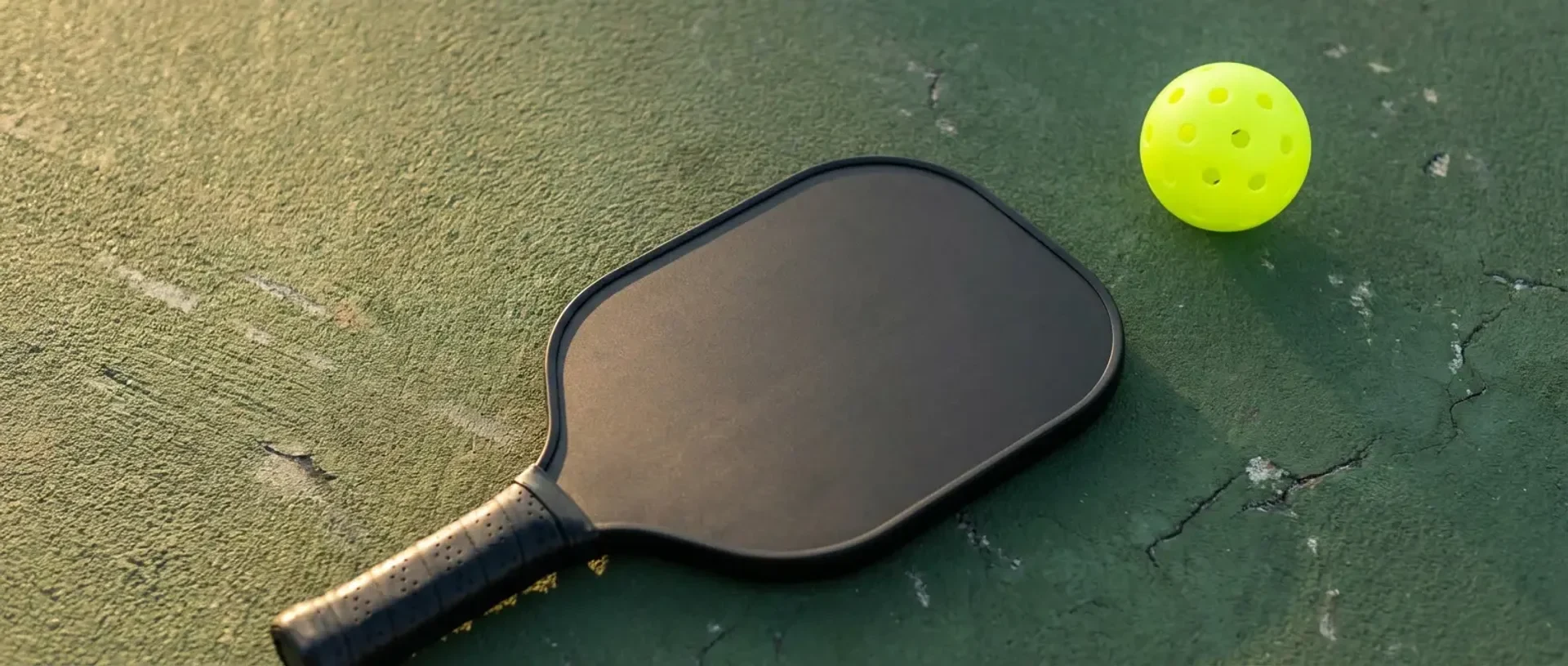
There's a moment that happens at every rec session. Someone shanks a third drop into the net, looks at their paddle like it betrayed them, and starts asking the group which new release everyone is playing. Sometimes it's a fair question. Most of the time, it's not.
Maybe it's not the paddles, guys. Or at least, maybe it's not the paddle as much as the marketing wants you to believe. There is real engineering inside a modern paddle, and there are measurable differences between a $79 starter and a $250 thermoformed carbon build. But the gap between what those differences actually do for your game and what the launch videos promise is usually wider than the gap between any two paddles on the rack.
I've spent enough time reading independent test data, listening to coaches who don't take brand checks, and watching players cycle through three paddles a year without changing their record to have a working theory. The paddle matters, but it matters in a narrower band than people think, and it matters more for some players than others. Here's the honest version.
Paddle attributes that actually matter
Static weight. The number on the scale, usually 7.3 to 8.5 ounces. Lighter paddles let you react faster at the kitchen line. Heavier paddles plow through the ball with less effort on drives and serves. Most players land between 7.8 and 8.2 once they figure out their preference. Going more than about half an ounce outside that band, in either direction, changes how your shoulder feels after two hours.
Swingweight. This is the one that separates real gear talk from forum talk. Swingweight measures how heavy the paddle feels in motion, not on a scale. Independent testers publish numbers from roughly 100 to 140, with most paddles in the 110 to 120 range.
Above 118 feels stout and adds plow through. Below 112 feels zippy and rewards fast hands. Two paddles with identical static weight can swing 10 points apart, and that gap is bigger than almost any spec on the box.
Twistweight. This is your sweet spot, measured honestly. Twistweight tells you how much the paddle rotates in your hand on an off-center hit. Numbers range from about 5 to 8. A paddle at 7.5 forgives a mishit that a paddle at 5.8 punishes. If you're stiffening up because you're afraid of the frame shot, twistweight is what you actually want, not a marketing line about a bigger face.
Face material and grit. Raw carbon fiber, especially T700, generates more spin than fiberglass and holds that grit longer than a sprayed-on textured surface. Independent spin testing puts most modern paddles in the 1,800 to 2,300 RPM range. Older or fiberglass paddles often live closer to 1,500 to 1,700.
Within carbon paddles, the gap between the spinniest paddle on the market and a mid-pack one is real but smaller than people assume, often 10 to 15 percent at the top end.
Paddle attributes that mostly don't matter
Color. Brand. Pro endorsement. Whatever flavor of the month launched last week. If you read enough launch copy you'll see phrases like infinite sweet spot, unmatched pop, revolutionary core. Sweet spots are not infinite. They're a measurable zone driven by geometry and weight distribution, and the data backs that up.
Pop has a hard ceiling now that USA Pickleball runs a Paddle-Ball Coefficient of Restitution test, with a 0.44 PBCoR limit. Paddles that exceed it get decertified. Anything you can legally buy and play with sits inside the same compliance window.
Pro endorsements tell you who got paid, not what plays best for you. Plenty of pros tweak their paddles with lead tape and grip builds until what they're using barely matches what they're selling. Brand loyalty is fine, but it isn't a performance attribute.
When the paddle holds you back
There are a handful of situations where the paddle is the actual problem. These are worth knowing because they're the only times an upgrade gives you a clean, immediate jump.
- Cracked face or visible delamination. A blistered face or a soft spot you can press into with your thumb means the paddle is dead. Tap the face with a knuckle and listen. A live paddle has a crisp, even tone across the surface. A dead one has a thud zone. Playing a delaminated paddle is also illegal in sanctioned play.
- Dead spots in the core. Even without delamination, paddles fatigue. Most last 1 to 3 years for rec players. Tournament regulars who play four times a week often replace every 4 to 6 months. If your dinks are dropping shorter than they used to from the same swing, the core may be done.
- Wrong weight for your body. A paddle that's too heavy makes you grip harder and overswing on resets. A paddle that's too light pushes you to muscle every shot. Both routes lead to the same place, which is a sore elbow and a worse fifth shot.
- Bad grip size. Adult grip circumferences run 4.0 to 4.5 inches. Too small and you'll squeeze. Too large and you'll lose wrist snap on rolls and serves. Wrap up to size with an overgrip if you're between, but don't ignore it.
- Fiberglass face above 4.0. Fiberglass is fine for beginners and gives nice pop, but at 4.0 and up the spin ceiling becomes a real cap. If you're trying to learn topspin rolls and your paddle won't bite the ball, you'll spend a year fighting your gear instead of your stroke.
How much improvement is realistic from a paddle upgrade
Here's where I'll be unpopular. For most players, switching from one decent paddle to another decent paddle is worth somewhere between zero and maybe a quarter of a DUPR point. Sometimes less. The honest range is small.
Switching from a damaged paddle to a healthy one, or from an entry fiberglass paddle to a real carbon paddle, that can be meaningful. You might pick up 100 to 300 RPM of spin you couldn't generate before. You might stop shanking the resets you were shanking because your twistweight went from 5.6 to 7.4. Those are real changes you can feel in a single session.
What a new paddle won't do is fix footwork, give you a shot you've never practiced, or make you patient at 7 all in the third. Coaches will tell you this in private even when they have a brand sponsor.
By skill level: who benefits most from upgrading
2.5. No. A 2.5 player with any USA Pickleball approved paddle in reasonable condition is held back by stroke fundamentals, not gear. Spend the paddle money on lessons or a ball machine.
3.0. Slight. A 3.0 starting to develop spin and reset shots will feel a difference moving from a fiberglass starter to a basic carbon paddle. Don't go premium yet. A solid mid-range carbon paddle does almost everything a $250 paddle does for a player at this level.
3.5. Real. This is where dialing in swingweight and twistweight starts to matter. A 3.5 grinding to 4.0 is hitting harder, defending faster, and feeling off-center contact more often. Demoing a few paddles and finding your weight window is genuinely useful here.
4.0 and up. Real, and worth being picky about. At 4.0 plus, you can feel a 5 point swingweight difference. You can feel 200 RPM of spin. You can tell when a paddle's balance point is two centimeters too high. Fit matters. Just remember the paddle still isn't going to add a shot you don't already own.
What to do before buying a new paddle
Before you put another order in, run this checklist. It's free and it answers the question better than a launch video.
- Film yourself. Two games on a phone propped against the fence. Watch your unforced errors. If they're footwork, balance, or shot selection, a new paddle won't fix any of them.
- Drill the shot you're missing. If your third drops are popping up, hit 200 of them with a partner before you blame the paddle. Most resets are technique, not material.
- Demo before you buy. Most reputable retailers have demo programs now. Play three sessions with a paddle before committing. The launch-week dopamine wears off in a week.
- Check your grip size. Hold the paddle in a continental grip and slide your other index finger between your fingertips and the base of your thumb. If it doesn't fit, the grip is too small. If it's loose, too big.
- Inspect your current paddle. Knuckle-tap the face. Press the surface with your thumb. Look for hairline cracks at the edge guard. If it's dead, that's your answer and it has nothing to do with the new release.
The paddle does matter. It just doesn't matter as much as the industry needs you to believe in order to keep selling you the next one. Get a healthy paddle in the right weight class with a face that suits your level, then go practice. That's the boring honest answer most coaches give once the cameras are off.
Frequently asked
Tap a question to expand.

Reader notes on this guide
Sign in with your email to post. We do not run ad networks; comments are moderated for spam and abuse.
Loading comments...
Sign in to add a comment.