
Third shot drop: how to hit one and when to use it
By My Pickleball Connect Team 6 min read
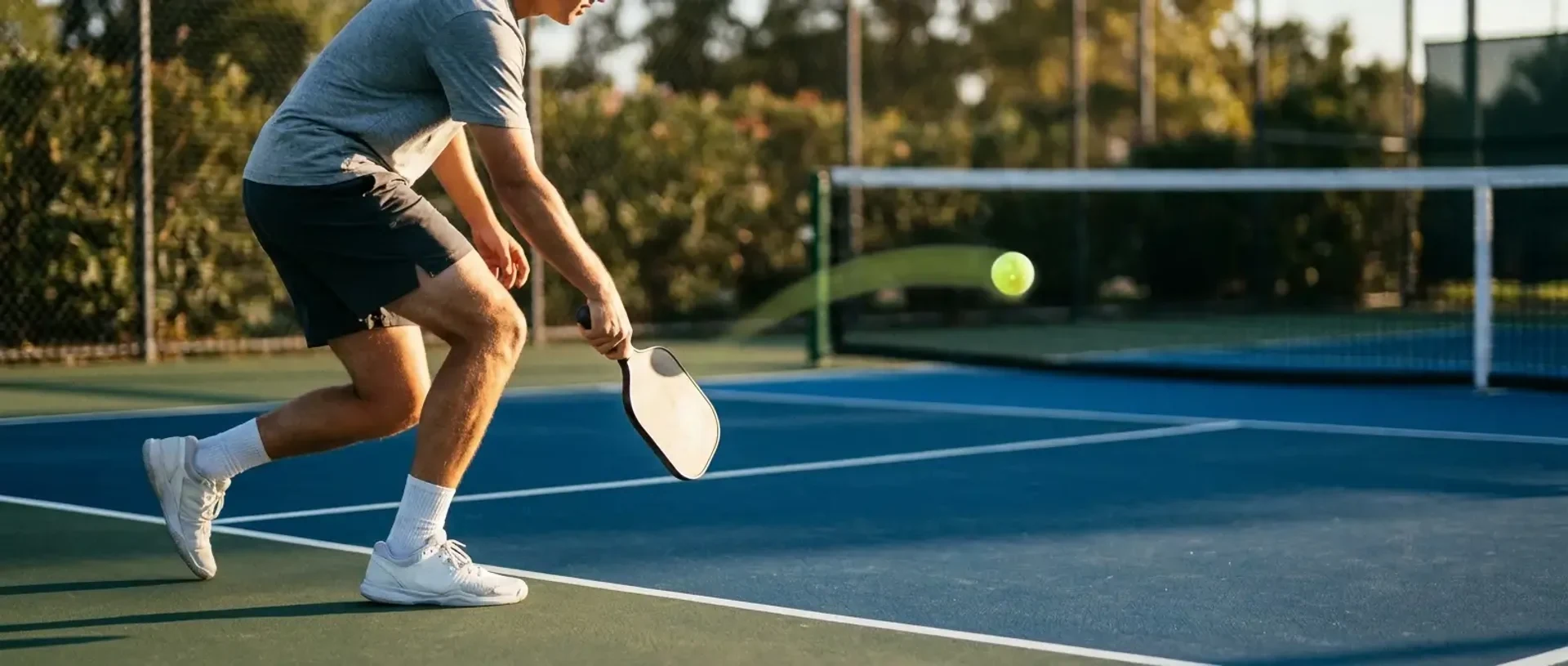
There's a moment in every rec game where you can tell who actually plays pickleball and who's still figuring it out. It's the third shot. The serve goes in, the return comes back deep, and the serving team is stuck twelve feet behind the baseline. What happens next decides the point.
If you can't drop a ball softly into the kitchen from there, you're going to lose most of your games against anyone competent. That's the reality of this sport above about 3.5.
Why the third shot even exists
The two-bounce rule is the whole reason. The serve has to bounce. The return has to bounce. That means the serving team can't charge the net on shot one or shot three without giving up the ball off the ground. Meanwhile the returning team is already at the kitchen line by the time their return lands, because they had time to walk in behind it.
So the serving team is down a position. They're deep. The other team is up. Every point starts with the serving team having to climb out of a hole, and the third shot is the ladder.
What a good drop actually looks like
A third shot drop is a soft, arcing ball that peaks somewhere around the net on your opponents' side and falls into their kitchen. Ideally it's dropping as it crosses the net, not still rising. If it's rising when it crosses, they're going to swat it out of the air and you're done.
Target height at the apex: maybe 6 to 8 feet, depending on how far back you are. Target landing spot: inside the kitchen, roughly centered or slightly to the weaker opponent's backhand. Not the line. Into the kitchen. Give yourself margin.
The ball should die. Low pace, low bounce, nothing for them to attack. If they have to hit up on it, you've won the exchange even though you haven't won the point yet.
Grip, swing path, contact
Continental grip. Same one you use for dinks. The swing is a lift from low to high, legs doing most of the work, shoulder quiet. Think of it as a long dink from the baseline, not a groundstroke with the volume turned down.
Contact is out in front, roughly at knee to waist height. Paddle face slightly open. No wrist flick, no snap. The paddle accelerates through the ball slowly and stops short. If you're following through past your shoulder, you're swinging too hard.
The ball is going maybe 35 feet and needs to climb and then fall. That's a lift, not a hit.
Drop or drive?
You don't always drop. A drive is the right call when:
- The return lands short and you can step in and take it rising
- Your opponents are weak off the bounce and you can pressure them into popups
- You're having a bad drop day and need to reset your own head
Drop when the return is deep, you're on your back foot, or your opponents are glued to the kitchen and any drive is going to come back at your face. Good players mix. They'll drive, drive, drop, drop, drive. The pattern is the point.
We have a full drive vs drop decision tree if you want to think through the inputs in depth, and the shake and bake guide for the coordinated drive-and-crash play that has become the default 2026 doubles answer when the return hangs up.
Footwork after you hit it
This is the part nobody teaches well. You hit the drop. Now what.
You walk. You do not sprint. Sprinting to the kitchen gets you there off-balance with your momentum carrying you into no-man's-land. A smart opponent hits it at your feet while you're still moving and you're cooked.
Take three or four steps forward, then split-step when they make contact. If your drop was good, you'll get to the kitchen by shot five or seven. If it wasn't, you stop at the transition zone, reset the ball into their kitchen, and drop again from there.
The transition zone is a place you pass through, but sometimes you have to pause there. That's fine. The transition zone guide walks the Traffic Light shot-selection rule and the shuffle-and-split-step pattern in detail. Our footwork guide covers the split-step and recovery patterns in detail.
Common failure modes
The drops that lose you points:
- Too flat. No arc, straight line over the net. They pick it out of the air and hammer it.
- Too deep. You landed it past the kitchen line. Now it's a midcourt sitter and they're crushing it.
- Too high. Beautiful arc, lovely apex, apex is at twelve feet. They have all day to set up and put it away.
- Stopped at the baseline. You hit a perfect drop and then didn't move. Congrats, you gave up the point you just earned.
- Panic drive. You meant to drop, you flinched, you drove it into the net. Pick a shot before the ball arrives.
A drill that actually works
Two people. You're at the baseline. Your partner is at the kitchen. They feed you a deep ball. You hit a drop. They let it bounce and dink it back at your feet in the transition zone. You take two steps in, hit another drop from there. They dink again. You step in and hit one more drop. Now you're at the kitchen and you dink out the point.
Ten of those in a row, both sides, every session. That's the drill. It mimics an actual point and it trains the movement as much as the shot. For more structured drills with a willing partner, see our partner drills guide.
Once you're at the kitchen, the next decision is whether to keep dinking or whether to speed up or reset, and our hands battle guide covers the rapid volley exchanges that decide most rallies once the ball gets sped up.
How long this takes
Honest answer: months. Maybe a year before it's truly reliable under pressure. The stroke is counterintuitive because every other racquet sport rewards pace and this one punishes it on the third shot. You'll hit hundreds into the net before you start feeling the lift. That's normal. Keep going.
The day your drop becomes a weapon instead of a liability is the day your rating jumps half a point. Nothing else in this sport pays you back like that.
Want a structured 4-week drilling program built around the drop specifically? Our 4-week third-shot drop drill plan sequences 12 drills (foundation, consistency, pressure, game integration) with measurable benchmarks per week, named-coach mechanics from Briones, CJ Johnson, and PrimeTime, and solo wall variants where partners aren't available.
Frequently asked
Tap a question to expand.
Should I learn the drop or the drive first?
Why does my drop keep going into the net?
Can I just drive every third shot and skip learning the drop?
Where exactly in the kitchen should the ball land?
Read next
- Playing Well
Is stacking in pickleball snobby? No. It is optimization. Snobbery is a separate, fixable problem.
- Playing Well
The 4-week third-shot drop drill plan: 12 drills, measurable benchmarks, and the partner pattern that installs the shot for good
- Playing Well
The 4-week pickleball reset drill plan: 12 drills, measurable benchmarks, and the partner pattern that breaks the popup-attack-popup spiral

Reader notes on this guide
Sign in with your email to post. We do not run ad networks; comments are moderated for spam and abuse.
Loading comments...
Sign in to add a comment.