
Pickleball third-shot drive vs drop: a decision tree built for real points
By My Pickleball Connect Team 11 min read Last reviewed
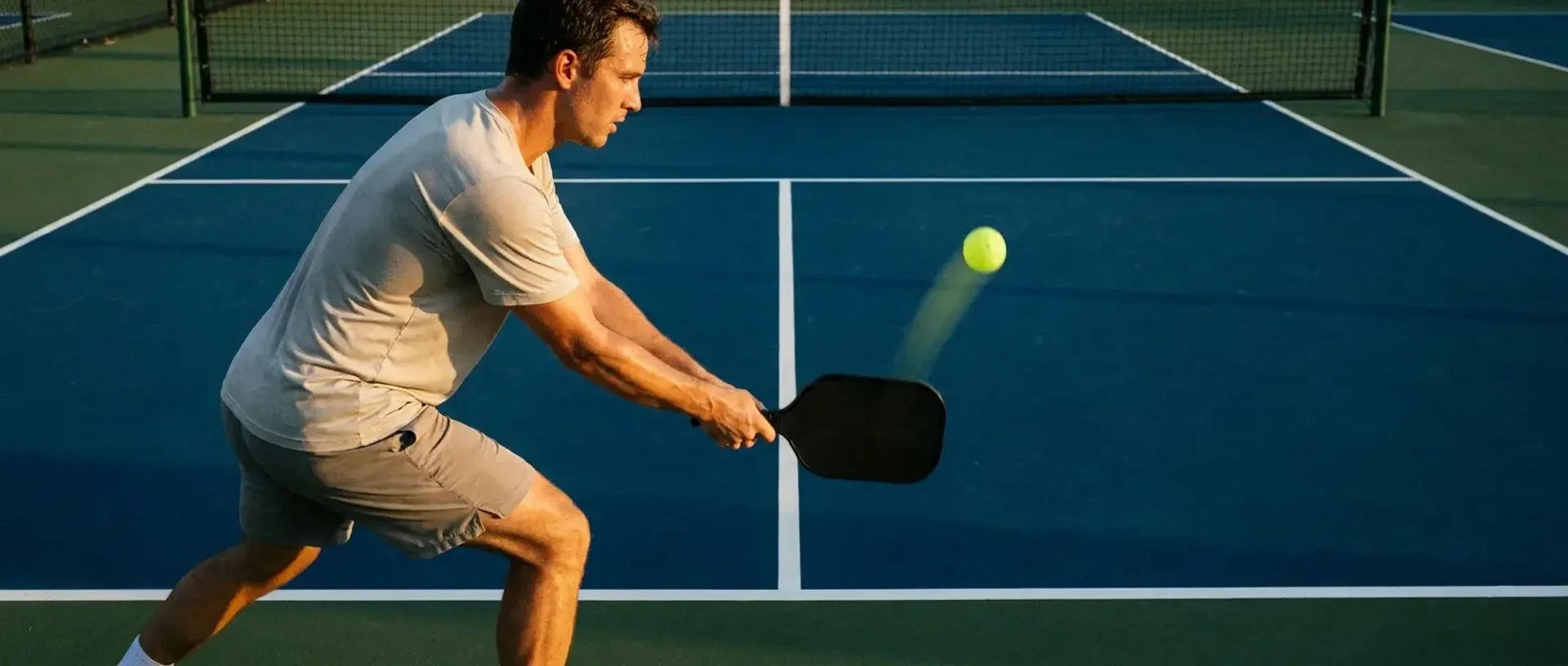
Drive the third shot when the return is short or floats at waist height and you have your feet set; drop it when the return is deep, you are still moving, or the opponents are camped at the kitchen line. Most third-shot errors come from picking the wrong shot for the ball, not from poor execution.
The third shot is the most strategic ball in pickleball. Your team is back, the other team owns the kitchen line, and you have to decide in about half a second whether to push the pace or buy time. Most rec players pick a default and stick with it. That is why they get stuck at 3.0 or 3.5. Real points are won by reading the ball in front of you and choosing the right tool.
This guide gives you a decision tree based on five inputs: return depth, your stance, partner position, opponent position, and the score. Use it during games. Then we will work through example scenarios and the mistakes that show up at every level.
The five inputs that decide the shot
Forget feel for a second. The right call comes from what you can see in the half second after the return crosses the net.
1. Return depth
The single biggest factor. Where does the ball land relative to your baseline?
- Deep (last three feet of the court or pushing you back): drop. You cannot generate a clean drive while moving backward, and you cannot get to the kitchen behind a drive from that far away.
- Medium (a few feet inside the baseline, around your knees): situational. Depends on your stance and the opponents.
- Short (inside the transition zone, anywhere from waist to chest height): drive. This is a gift. Make them play a low ball at the kitchen, then close.
2. Your stance
Are your feet set, or are you still moving when you make contact?
- Set, balanced, weight forward: drive is on the table.
- Drifting back, weight on heels, or stretched: drop only. A drive from a bad base is a feed.
3. Partner position
If your partner is already at the kitchen line and you are deep, your drop or drive needs to give them cover. A drive that pops up gets crushed at their feet. A drop that floats puts them in a 1-on-2 hands battle.
4. Opponent position
- Both opponents at the kitchen line, set: a drive needs to be heavy and low or it gets countered. A well-disguised drop is often the safer aggressive choice.
- One or both opponents still in transition: drive at the feet of the deeper opponent. They cannot reset a hard ball while moving forward as easily as a set player can.
- One opponent is a known counter-puncher: avoid driving directly at them. Drive to the partner or drop.
5. Score and momentum
Down 8-2 is not the time for a low-percentage drop you have shanked twice. Up 9-3 is not the time to get cute. Pick the shot you can execute under pressure for the situation in front of you.
The decision tree
Read this top to bottom. Stop at the first answer that fits.
- Is the return short and inside the transition zone, with a bounce above your knees? Drive. Then close.
- Is the return deep enough to push you back, with you not yet set? Drop. Buy time.
- Are you set, balanced, and the bounce is medium height around the baseline? Drive if both opponents are still moving forward; drop if both are set at the kitchen.
- Is your partner stuck deep with you? Drop. Driving from a 2-back position is a low-percentage attack and you have no cover up top.
- Is the score tight (within two) and you have not landed a drop in the last three tries? Drive. Use what is working.
- Default to the drop. The drop wins more long-term points than any other third shot.
For a deeper look at the drop itself, the mechanics, the contact point, and where to aim, see our third-shot drop explained guide.
"Split it": drive with intent to follow forward
There is a third option that most players ignore. Hit a drop with shape, on a trajectory that lets you take three quick steps forward as you hit. You are not committing to the kitchen line on the third shot. You are getting halfway there and using the fifth shot to close.
This is sometimes called the "shake and bake" setup or, more honestly, just "playing the transition zone." Pros do this on most third shots that are not clean drops or clean drives. The ball is shaped low enough to be hard to attack, but you do not freeze waiting to see what happens. You move with the ball.
Five example scenarios
| Scenario | Inputs | Right call |
|---|---|---|
| 1. Deep, dropping return at your feet | Return lands a foot from the baseline, you are still backpedaling, opponents are at the kitchen. | Drop. Land it in the kitchen, then take three steps forward and split-step. |
| 2. Lazy short return, knee high | Return floats and lands four feet inside the baseline, you are set, opponents at the kitchen. | Drive at the inside hip of the opponent on your forehand side. Close immediately. |
| 3. Medium return, opponents in transition | Return is medium depth, you are set, opponents are still walking up after a soft return. | Drive at the feet of the deeper opponent. They cannot drop and move at the same time. |
| 4. Deep return, partner already up | Your partner poached and is at the kitchen, you are deep with a deep return at your feet. | Drop. A drive that pops up sells your partner out. |
| 5. Score is 9-9, drops have been shanky | Tight game, your last two drops landed mid-court and got attacked. | Drive. Pick the shot with the lower variance for the moment, even if it is not the prettiest. |
| 6. Lefty stack, return down the middle, medium | Both opponents set, return at the T, you are set with a forehand. | Drive down the middle. The seam is the highest-percentage drive target on a set defense. |
Common mistakes by skill level
3.0 players
The biggest leak is driving every third shot because it feels assertive. The opponents at the kitchen reset the drive, then you cannot get up. You play the rest of the point from no-mans-land and lose. If you are stuck at 3.0, drops are the way out. We wrote a full guide on the patterns that hold players back: how to break out of 3.0 pickleball.
Other 3.0 mistakes:
- Driving from behind the baseline. The ball travels too far, your contact is rushed, and the drive lands at the kitchen line where it gets pasted.
- Aiming the drop at the kitchen line instead of three feet inside it. The line drop is the highest-margin error in the sport.
- Stopping after the third shot and watching. You have to move forward on every drop you hit, period.
3.5 players
Better mechanics, but the read is still off. The classic 3.5 mistake: they drop when the ball was begging to be driven. A short, knee-high return at your forehand is a free point if you drive it. Dropping it just hands the kitchen back to opponents who were going to give it to you.
Other 3.5 patterns:
- Driving the same shot twice in a row when the first one got reset cleanly. Mix it up.
- Overcommitting to the kitchen after a mediocre drop. If your drop landed waist high, do not run all the way in. Stop in the transition zone, split-step, and reset the next ball.
- Driving cross-court instead of at body. Cross-court drives give the opponent more time and angle. Body drives jam them.
4.0 and up
At 4.0+, the third shot becomes a setup, not a finishing shot. The drive is intended to draw a pop-up that the partner crashes (the "shake and bake"). The drop is intended to neutralize, then win the kitchen exchange three or four shots later. Players who plateau at 4.0 usually have one of two issues:
- They drive without a partner crash plan. The drive lands clean, the opponent resets, and now you are scrambling.
- They drop and then play passive at the kitchen. A good drop earns you the kitchen line; you still have to win the dinking exchange. See our dinking strategy guide for the patterns that turn a neutral kitchen into a point.
Drill these reads, do not just play
Reading the return takes reps. Mixed-depth feeds from a partner for ten minutes teach you more than ten games. Call out "drive" or "drop" before contact, then execute. For drop accuracy, set a cone three feet inside the kitchen line and aim to land soft balls between the cone and the line.
Quick reference card
| Return | You | Opponents | Call |
|---|---|---|---|
| Deep, at feet | Moving back | Both at kitchen | Drop |
| Short, knee high | Set | Both at kitchen | Drive |
| Medium, waist high | Set | Both at kitchen | Drop with shape, follow forward |
| Medium, waist high | Set | One in transition | Drive at the deeper opponent |
| Deep | Set, on forehand | Both at kitchen | Drop |
| Short | Set, partner already up | Both at kitchen | Drive at body, partner crashes |
If you want to zoom out from the third shot to the larger doubles patterns at each rating, our doubles strategy by skill level guide covers the build from 3.0 through 4.5.
The honest summary
You do not have to pick a side. Players who only drop get pushed around by aggressive returners. Players who only drive get walked off the court by patient teams that reset everything. The skill is reading the ball and the players in front of you, then picking the shot that fits. Build both shots in practice, then trust the read in games. That is how you stop losing points off your own paddle on the third shot.
For a side-by-side of how Briones, CJ Johnson, Tyson McGuffin, and PrimeTime each frame the drive choice (the rec-level frequency question, the shake-and-bake set play, and the U-shape across rating levels), see our coach meta-analysis on the third-shot drive.
References
Frequently asked
Tap a question to expand.
Should beginners drive or drop the third shot?
How deep does a return have to be before I should drop instead of drive?
Why do my third-shot drives keep getting attacked?
Is a third-shot drop or drive better against bangers?
What is a 'split-step' drop and when should I use it?
How do I know when to use the 'shake and bake'?
Read next
- Playing Well
Is stacking in pickleball snobby? No. It is optimization. Snobbery is a separate, fixable problem.
- Playing Well
The 4-week third-shot drop drill plan: 12 drills, measurable benchmarks, and the partner pattern that installs the shot for good
- Playing Well
The 4-week pickleball reset drill plan: 12 drills, measurable benchmarks, and the partner pattern that breaks the popup-attack-popup spiral

Reader notes on this guide
Sign in with your email to post. We do not run ad networks; comments are moderated for spam and abuse.
Loading comments...
Sign in to add a comment.