
Pickleball doubles strategy by skill level: 3.0, 3.5, and 4.0+
By My Pickleball Connect Team 13 min read
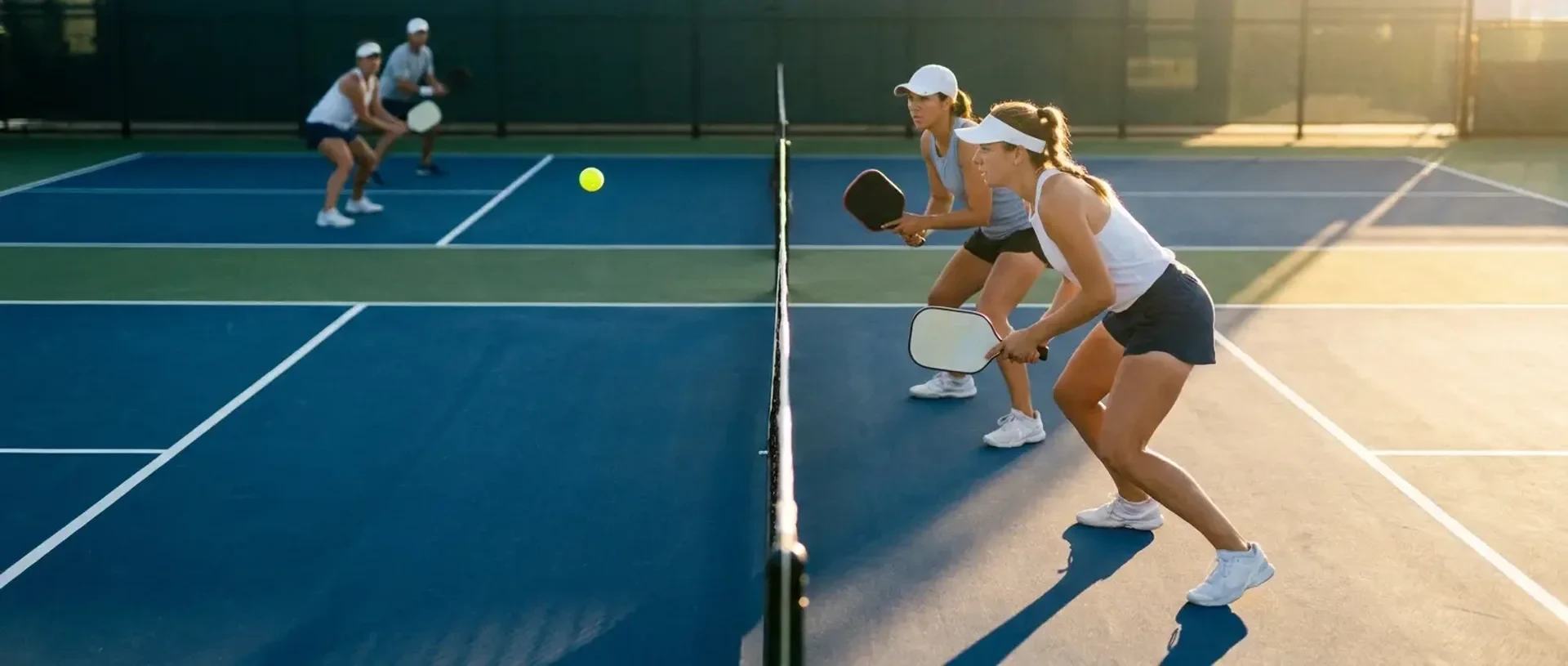
Pickleball doubles strategy comes down to three things at every level: control the kitchen line, win the third shot exchange, and pick the right ball to attack, but what those three things actually mean changes a lot between 3.0 and 4.0 play.
The reason the popular listicle guides leave you flat is that they hand the same seventeen tips to a player who still pops up backhand dinks and a player who is refining a counterattack pattern.
Advice that a 4.0 hears as obvious is useless to a 3.0 who cannot yet execute it, and advice tuned for a 3.0 is holding a 4.0 back. What follows is segmented by what you can actually do on a court this week, not by what sounds strategic on paper.
The three constants at every level
Before you split the levels, the shape of the game is the same. These three are the only non-negotiables.
- Control the kitchen line. The team whose two players are both stationed at the non-volley zone line with paddles up wins most points. Full stop. Almost every strategic concept underneath this is about either getting there, keeping the other team from getting there, or pushing them off it.
- Win the third shot exchange. The third shot is the serving team's bridge from the baseline to the kitchen. If you hit a good one, you are attacking the net as a unit. If you hit a bad one, the other team gets a high ball and crushes it. The fourth and fifth shots, what coaches call the transition sequence, belong inside this idea too.
- Pick the right ball to attack. The single most reliable signal in the sport is ball height relative to the net. A ball above the net that is coming at you soft is attackable. A ball below the net is not, no matter how badly you want to end the point. Every level gets this wrong. The higher you climb, the less often you get it wrong.
Those three are the skeleton. What changes between levels is which parts of the skeleton you can actually control on purpose.
Nobody set at the line. Points end on unforced errors.
3.0 doubles strategy
If you are a 3.0, the fancy stuff is not what is holding you back. The basics are. A 3.0 loses most points on unforced errors, not on being outplayed, which means the fastest path to winning more games is subtraction, not addition.
Hit a deep return, every single time. The return is the easiest shot at this level to screw up by overcomplicating. Aim for the back third of the opponent's court. Do not try to angle it. Do not try to add spin.
A high, deep, down-the-middle return gives you more time to get to the kitchen line than any clever return you can invent. A short return, one that lands near the service line, hands the serving team a knee-high ball they can drive at your feet before you have set up.
Get to the kitchen line and stay there. As the returning team, the move is automatic: hit the return, walk to the line, put your paddle up in front of your chest. As the serving team, your job is harder, because you have to play a third shot first.
Either way, no-man's-land, the strip of court between the baseline and the kitchen, is where points are lost at 3.0. Do not stop there. If you are going to be caught in the middle, be caught moving forward, not standing.
Drop the third even if it floats. At 3.0, you will not hit perfect drops. That is fine.
A floaty drop that lands somewhere in the kitchen, even if the other team volleys it back at you, is still a better outcome than a drive that pops up for a winner or a drive that gets blocked at your ankles while you are stuck at the baseline.
Committing to the drop, hitting it with a relaxed grip and a low-to-high push, and then moving forward, even just three or four steps, is the single highest-impact pattern at your level. Our third shot drop guide walks through the mechanics in detail.
Call your shots. Loudly. 'Mine' and 'yours' are the only two phrases you actually need in a rec game. Any ball down the middle is a middle ball, and middle balls are where 3.0 partnerships bleed the most points. Pick which of you owns the middle (default is whichever player has their forehand there) and call it early. A shouted 'mine' three feet after contact is not a call, it is an apology.
Avoid the things you have not practiced. No ATPs. No around-the-post bangers. No attacking a dink from below the net just because your paddle felt fast that minute. Your ceiling at 3.0 is set by how rarely you make unforced errors, and unforced errors are almost always shots you have no business trying. If you want drills that specifically move this needle, our 3.0 to 3.5 guide is built around them.
The third-shot drop has been made; your team is moving up.
3.5 doubles strategy
At 3.5, the raw mechanics are working more often than not. Your third drops get there. Your backhand dink does not flinch. What separates a 3.5 from a 3.0 is not a new shot. It is the start of real shot selection. You are beginning to decide, point by point, what kind of ball is in front of you.
Read attackable versus not, honestly. The ball-height rule finally starts paying off here. Above the net and at waist height or higher, you can attack. Below the net or at your feet, you reset or dink. Most 3.5 players can see this intellectually.
Acting on it under pressure, especially on a ball that is just barely below the net, is the real skill. A ball you thought was attackable but was actually at waist height with no pace is a pop-up waiting to happen.
Drive versus drop, based on the return you got. The third shot stops being a one-size choice. If the return lands deep and at your feet, you drop. If the return floats short and you can step inside the baseline to meet it at waist height, you drive.
Mixing in a drive keeps the opponents from parking at the kitchen waiting for your drop. Coaches teach this as reading the return before you decide the third, not deciding the third before you see the return.
Cover the middle, especially when stacking. If you have started playing with the same partner and you are experimenting with stacking, middle coverage is where stacks break down. Our stacking guide covers the signals and the switches. The thing it cannot do for you is build the instinct to call 'mine' on a middle ball a half-second earlier than you did last game. That instinct is what 3.5 teams are actually building.
Recognize a popup and finish it. At 3.0 a popup is a chance you usually waste. At 3.5 it is a point you are starting to convert. The mechanics of finishing a popup are simple: contact out in front, paddle face closed over the ball, aim at feet or the closer shoulder of the player who popped it. Do not swing harder. Swing shorter and more compact. The popup is already on your racket. Just redirect it down.
Start resetting from the transition zone. Nobody at 3.0 can do this on purpose. At 3.5 it becomes a deliberate tool. You are not at the kitchen line yet but the other team is, and a hard ball is coming at you low.
You bend the knees, soft hands, and push a shot that lands in the kitchen with no pace. You are not trying to win the point. You are trying to neutralize the attack and keep moving forward.
Coaches describe this as the ladder: every ball from the transition zone either climbs you up the ladder toward the kitchen, or knocks you back down. Reset volume is how 3.5 players survive 4.0 opponents.
The dink and the hands battle decide rallies.
4.0+ doubles strategy
The 4.0+ game is where shot selection hardens into patterns. You are not just picking the right ball to attack, you are running specific sequences that you have drilled, that your partner knows, and that you can execute under pressure. This is where strategy stops being advice and becomes the thing you can actually see on court.
Speed up off attackable balls with intent. Not every attackable ball is the same attack. A ball above the net at the kitchen line is a flick or a roll to the opponent's dominant shoulder or between the two players.
A ball above the net in the transition zone you are moving through gets driven at the feet of the nearest opponent. The target is almost always a body, not a line. Teams at this level rarely hit winners out of the air off the kitchen.
They create pop-ups from the first speed-up and the partner puts it away on the second.
Stack and switch with purpose, not as a costume. Full stacking, half stacking, and situational switching are all available to you at 4.0.
The 4.0 question is not 'should we stack' but 'what is this stack actually getting us.' If it puts your forehand in the middle against a team that keeps feeding the middle, do it.
If it asks your partner to cross behind you on a return that the opponents can hit hard and deep at the crossing shoulder, skip it. The stack is a tool that answers a specific threat, not a badge.
Target the weaker opponent without being obvious. You identify the weaker side within three points. You feed that player neutral dink exchanges to tire them out. You send them the tough middle dink on a key point.
You run your drive at the backhand of whichever one has the worse one. None of this requires an ego moment.
It requires that you and your partner agree, silently, on who you are trying to get the ball back from and then stick to the plan for the whole game.
Win the hands battle by blocking first, attacking second. When a speed-up comes at your chest, the rec instinct is to swing back. The 4.0 instinct is to take pace off, block the ball into the kitchen with an open face and no backswing, and reset the point.
Matching pace with someone who started the exchange favors the attacker. Absorbing and returning a soft ball into the kitchen takes the point back.
Only after you have re-neutralized do you look for your own attack, and the attack you pick is downward, aimed at the opponent's feet, not flat back at their chest.
Reset from transition like it is a drill. You are past the point where transition-zone resets are survival shots. They are a planned shot. The mechanic is the same as at 3.5, but now it runs on autopilot.
Paddle out in front, knees bent, contact in front of the front leg, push through with the legs, not the arm. You take two shuffles forward after the reset. If the next ball is also attackable, you reset again.
You only attack from transition when the ball is clearly high and slow, which is rare.
The decision tree everyone needs
Strip all of this down and almost every ball at the kitchen or in the transition zone answers to one question: where is the ball relative to the net, and where are your feet. The tree below is what most coaches teach, in the exact order they teach it.
- You are at the kitchen, ball is at your feet or below the net. Dink. Soft, controlled, into the kitchen, preferably crosscourt. Do not attack. Do not lift it.
- You are at the kitchen, ball is at waist height or higher, not a hard drive. Attack. Compact motion, target body or between-players seam.
- You are at the kitchen, hard speed-up incoming at your chest. Block. Open face, no backswing, drop it into the kitchen.
- You are in the transition zone, ball is below chest. Reset. Soft shot into the kitchen, take two steps forward.
- You are in the transition zone, ball is clearly high and slow. Attack it down and keep moving. This is rare.
- You are at the baseline and it is the third shot, return was deep and at your feet. Drop. Not a drive.
- You are at the baseline and it is the third shot, return floated short and you can step inside the baseline. Drive. Target feet.
Print this, or don't, but play for a week where every ball you hit gets mentally checked against it. The gap between a 3.5 and a 4.0 is mostly whether this tree runs automatically or whether you are still thinking about it.
Position by phase of point
Court position changes twice during every single rally: when the serve is about to be hit, and when the ball crosses into both-teams-at-the-kitchen mode. Knowing which phase you are in tells you where to stand.
Serving team, baseline phase. Both players behind the baseline. The non-serving partner does not creep in. You want enough space behind you that a deep return does not handcuff you. Stay wide enough that the return cannot split you, but not so wide you leave the center exposed.
Returning team, kitchen rush phase. Return is hit, the returner sprints to the kitchen line. The partner, who has been up the whole time, stays put. You are both at the line before the third shot arrives. This moment, the half-second before the third, is when most 3.0 teams are still scrambling and most 3.5 teams are already set. The difference is the decision to move, not the speed.
Both teams at the line, micro-positioning phase. Stand slightly off the center of your half, not hugging the sideline. Your partner mirrors. If the ball goes wide to your partner, you slide toward the middle to cover the seam.
If the ball goes wide to you, your partner slides toward the middle. The two of you move as one unit, not as two players defending their own columns.
Coaches call this the string, as if you are tied together by a piece of elastic, and it is the single clearest visual cue for watching 4.0 doubles.
Both teams at the line, someone retreats. Someone hit a bad dink and has to back up to play a lob, or someone is being pushed off the line by a deep middle dink. The partner does not stay fixed. The partner slides with them. Leaving your partner isolated in the back while you stay at the line is how you eat a between-you winner.
Mental game by level
The mental work is level-dependent too. The same advice lands different at each rung.
At 3.0, the biggest mental hurdle is shot tolerance. You have to be willing to play the ninth ball in a dink rally, and the tenth, and the eleventh, without forcing. Most 3.0 unforced errors happen because the player ran out of patience before their opponent did. Not because the shot was hard.
At 3.5, the hurdle is not getting tilted by unforced errors. You will make them. You will also lose points on hooks and bad calls.
The mental task is to flush the last point completely before the next serve, because the spiral from one missed drop into three missed drops is a 3.5 signature problem.
Our line calls guide covers the actual rule, which helps, but the mental piece is separate: the call is made, it is gone, next point.
At 4.0, the hurdle is tempo. You know what to do. The challenge is getting the other team off the rhythm they want. You slow the point down when they like fast hands. You speed up when they want to dink you into a mistake. You take the extra second on your serve, or you quick-serve. You are managing pace at a level that 3.5 players cannot yet see.
All three levels share one thing. The players who beat their opponents are usually the ones who beat themselves less often. Unforced errors are the account. Pay in, pay in, pay in, and eventually the account goes into overdraft and you lose the game.
Drills that match the strategy
One drill per level. Pick the one that matches where you actually play, not the one that sounds most advanced.
3.0 drill: deep return with forward movement. Partner serves ten balls. You return each one past the service line, aiming for the back third of the court, then sprint to the kitchen line before the next feed.
Score yourself on two things, not one: the return has to land deep, and your feet have to be at the kitchen before a hypothetical third shot arrives. You do not get credit for a deep return that left you stuck at the baseline.
Ten reps, three sets, twice a week.
3.5 drill: transition-zone reset ladder. Partner at the kitchen line, you at the baseline. Partner feeds a medium-pace drive at your feet. You reset into the kitchen, take two steps forward. Partner drives again. You reset again.
You are trying to ladder yourself from baseline to kitchen across four to six resets without popping one up. The drill teaches the one skill that lets you survive the 3.5-to-4.0 crossover: the soft push from the hardest place on the court to hit a soft push from.
4.0 drill: speed-up, block, reset, repeat. Both partners at the kitchen line. Cooperative dinking for three to four balls, then one of you speeds up at the other's chest on a coaching cue. The other blocks, low into the kitchen.
The attacker resets if the block is good, or attacks again if the block pops up. Keep the rally alive through three speed-up sequences before anyone tries to win.
The drill teaches the thing that actually separates 4.0 from 3.5: the habit of absorbing pace without giving the point away, and finding your own attack only after you have neutralized theirs.
One last thing to carry into any of this. The players who move up are the ones who spend time on drills that look boring on paper. Fast-forwarding to strategy you cannot yet execute is the most expensive kind of wasted session. For the positioning fundamentals underneath all of this, see doubles positioning fundamentals. For how partners actually communicate inside these patterns, calls, signals, and talking between points.
Frequently asked
Tap a question to expand.
What is the single biggest strategic difference between a 3.0 and a 4.0 player?
Should a 3.0 player try to stack?
When should I drive the third shot instead of dropping it?
Why do I keep losing to 4.0 players even when I hit good shots?
Read next
- Playing Well
Is stacking in pickleball snobby? No. It is optimization. Snobbery is a separate, fixable problem.
- Playing Well
The 4-week third-shot drop drill plan: 12 drills, measurable benchmarks, and the partner pattern that installs the shot for good
- Playing Well
The 4-week pickleball reset drill plan: 12 drills, measurable benchmarks, and the partner pattern that breaks the popup-attack-popup spiral

Reader notes on this guide
Sign in with your email to post. We do not run ad networks; comments are moderated for spam and abuse.
Loading comments...
Sign in to add a comment.