
What is stacking in pickleball: how it works, when to use it, and the etiquette
By My Pickleball Connect Team 10 min read
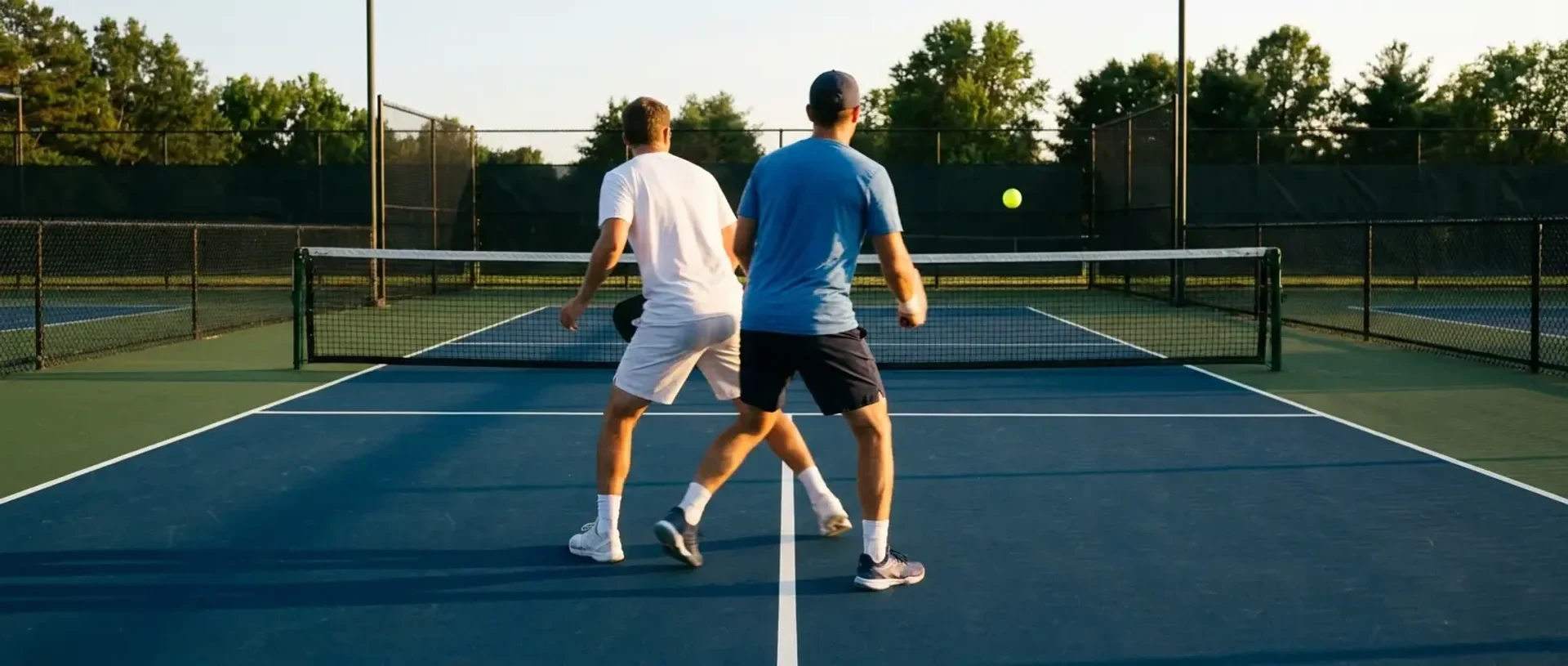
Stacking is the doubles tactic where both partners line up on the same side of the court before the serve so that, the moment the ball is struck, they can shift into the sides they actually want to play. It is not a trick play and not a rule loophole.
It is a way to keep two forehands in the middle of the court, hide a weaker backhand, or protect a left-handed player's strong side.
People bother with it because the middle of the court is where most balls go, and whoever owns the middle with a forehand usually controls the rally.
This guide is the technique-and-rules layer (how stacking actually works, the legal mechanic, the signaling, the etiquette debate). For the coach-aggregation meta-analysis (Briones, CJ Johnson, Tyson McGuffin, and PrimeTime on when stacking pays off and when it doesn't), see our stacking coach take.
The mechanic
The first thing to understand is what the rulebook actually requires.
USA Pickleball Rule 4.B.7 says only two things have to be correct at the moment of the serve: the right player has to serve from the correct service court (right/even when the score is even, left/odd when it is odd), and the right player has to receive in the diagonally opposite box.
Everyone else, the server's partner and the receiver's partner, can stand anywhere on their team's side of the net, including completely off the court behind the baseline or out past the sideline. That single rule is what makes stacking legal.
Here is the classic stacking setup, with two right-handed players who both want their forehand in the middle. Say the server's score is even, so the server has to stand in the right service box.
Their partner, instead of standing on the left side as in a traditional alignment, stands a step or two outside the right sideline, near the baseline, off the court. The server hits the serve.
As soon as the ball crosses the net, the server slides left toward the middle, and the partner steps in from outside the court and takes the right side. Now both forehands face the middle of the court.
On the return side it works the same way in reverse.
The receiver stands in the correct diagonal box, but the partner who would normally be at the kitchen on the other side instead stands close to the same sideline as the receiver, often just past the centerline on the receiver's side, ready to slide the other way once the return is struck.
After the receiver hits the return and starts moving up, the partner crosses behind them to the open side. The team ends up in the configuration they prefer, with the correct player having served or returned from the correct box.
The non-hitting partner can also stand fully outside the sideline on the return, which is what most pros do, because there is no rule saying they have to be on the court. They only need to be on their team's half of the net.
Why teams stack
The strategic case for stacking comes down to three repeating reasons.
Forehands in the middle. In doubles, the seam between the two players is where most attackable balls travel. If you have one righty and one lefty, stacking lets you put both forehands in the middle for every point.
Ben Johns and Collin Johns built the most decorated men's doubles run in the sport on a version of this: Ben played the left side for every single point, Collin played the right, and they won 33 PPA titles together before splitting up.
Ben's lefty-style attacking backhand roll lived in the middle. Collin's job was to be the consistent right side and feed the middle to his brother.
Lefty-righty pairings. Even at rec levels, mixing handedness changes everything. Without stacking, half your points have a backhand-backhand seam in the middle, which is the worst possible defensive shape. With stacking, every point starts with two forehands flanking the centerline.
Hiding a weaker side. If one partner has a shaky backhand drive but a confident forehand, parking them on the left where their forehand covers the middle reduces how often they get attacked on the backhand. Same logic with mixed doubles, where teams often stack to keep the stronger player's forehand on attackable balls down the middle.
Full stacking vs half stacking
You will hear coaches draw a clean line between two versions of the tactic.
Full stacking means you stack on every point, both when you serve and when you return. Each player ends up on the same side every single rally. This is what the Johns brothers did. The advantage is total consistency.
The cost is that returning while stacked is harder: one of you has to cross behind the receiver while the receiver is still moving forward, and a deep, hard return into the body of the crossing player can blow the whole pattern up.
Half stacking means you only stack on one phase, almost always the serve. You serve stacked, because that is the easier of the two, and on returns you go back to a normal alignment and accept that one player will be on their non-preferred side for that point.
Most rec teams who say they stack are really half stacking. It captures most of the benefit, asks less of your footwork, and removes the worst failure mode (a botched return-side switch that leaves the court wide open).
How to call it on the court
Stacking only works if both partners know what is happening on every point, including the score, who is serving, and whether you are switching this rally. The standard signaling system, used by pros and most 4.0+ rec players, lives behind the back of the player at the kitchen line, hidden from the opponents. The receiver's partner is usually the one giving the signal because they are facing forward.
- Open hand, fingers spread: we are switching this point. Stack.
- Closed fist: staying as we are. No stack.
- Wiggle or hang-loose: a fake, used to bait opponents who are watching for a switch.
Verbal calls work fine in rec play. 'Stack' or 'switch' or 'normal' right before the serve is enough. The important thing is that both players know the score, because stacking decisions depend on whether the server is on the even or odd side. A common practice is for the player at the baseline to call the score loudly, then the player at the kitchen flashes the signal, then the serve goes.
When NOT to stack
Stacking is not a free upgrade. There are situations where it makes you worse.
Skip it if both partners are roughly equal on both sides. If neither of you has a meaningfully stronger forehand or a glaring backhand weakness, the geometry gain is small and the coordination cost is real. Most coaches make the case bluntly that beginners should not stack at all, because the better use of those reps is fixing the weak side rather than hiding it.
Skip it if your partner is uncomfortable with the footwork. A botched switch, where both players end up on the same side or both leave the middle open, is worse than any side-preference advantage you were trying to capture. Watch lower-intermediate teams try to unwind a return-side stack and you will see this happen multiple times a game.
Skip it against opponents who target transitions. Strong teams will hit hard, deep returns at the body of the crossing player or directly into the seam during your switch. If the team across the net is good enough to punish movement, full stacking can cost you more points than it wins.
Skip it when the score is critical and you have not drilled it. A 9-9 timeout is not where you debut a new pattern.
The rec-play etiquette debate
The technical question of whether stacking is legal was settled long ago. The cultural question of whether you should stack in casual open play is not. A r/Pickleball thread last year accusing 'stacking snobs' of ruining open play picked up several hundred upvotes and a few hundred comments, and the discussion has not really cooled since.
The complaint is fair to repeat in its strongest form. Open play, in most communities, is built around rotation: random partners, random opponents, four games and out, paddles in the rack. When a foursome shows up wanting to play together for an hour, run their stacked pattern, refuse to mix in, and ask incoming players 'do you stack?' as a screening question, the format breaks. People who came to play with strangers feel pushed out.
The defense is also fair. Stacking is a normal piece of doubles strategy. A 4.5 player paired with a 2.5 by random rotation is not a fun game for either of them. If two regular partners want to stack a few games together while waiting for a real session, that is not gatekeeping, it is just doubles.
A workable line for rec play: in true open-play rotation, default to a normal alignment and play whoever shows up. Save stacking for when you have a fixed partner, are playing a known group, or are in challenge-court / king-of-the-court formats where teams stay together by design.
Asking your random partner 'want to stack? I'm a lefty' before the first point is fine. Demanding it, refusing to play partners who don't, or treating non-stackers as a problem is what people are actually complaining about. The mechanic is not snobby. The attitude can be.
Common stacking mistakes
A short list of the failure modes that show up most in rec games.
- Forgetting the score. Stacking decisions depend on which side the server is on. Lose track of the score and you will have the wrong player serving, which is a fault.
- Switching late on the return. The crossing partner has to read the return and start moving as the receiver hits, not after. Late crossings leave the middle wide open for the opponents' first volley.
- Standing too far off the court. The off-court partner needs to be one or two steps from the sideline, not five. The longer the path back in, the more time you give a return down the line.
- Stacking without signaling. If only one partner knows the plan, you will get caught in formation, both end up covering the same half, and lose easy points.
- Stacking every single point reflexively. If you are not actually getting a forehand-in-the-middle benefit out of it, you are paying coordination cost for nothing. Half stack on serves, normal alignment on returns is a perfectly good default.
- Stacking to look advanced. If you cannot reliably win the side you stack into, fix the side first. Hiding a 3.0 backhand by stacking does not make it a 4.0 backhand.
Where this fits
For the rec-etiquette playbook on how to stack at open play without making the rotation feel weird, see stacking in rec pickleball etiquette. For the operator's POV on whether stacking is actually snobby, see is stacking in pickleball snobby? For the multi-coach meta-analysis with mechanics from Briones, CJ Johnson, and PrimeTime, see our stacking coach take.
Frequently asked
Tap a question to expand.
Is stacking against the rules in pickleball?
What's the difference between full stacking and half stacking?
Should beginners stack?
Is it rude to stack in rec open play?
Read next
- Playing Well
Is stacking in pickleball snobby? No. It is optimization. Snobbery is a separate, fixable problem.
- Playing Well
The 4-week third-shot drop drill plan: 12 drills, measurable benchmarks, and the partner pattern that installs the shot for good
- Playing Well
The 4-week pickleball reset drill plan: 12 drills, measurable benchmarks, and the partner pattern that breaks the popup-attack-popup spiral

Reader notes on this guide
Sign in with your email to post. We do not run ad networks; comments are moderated for spam and abuse.
Loading comments...
Sign in to add a comment.