
Pickleball speed up vs reset: the kitchen-line decision tree
By My Pickleball Connect Team 9 min read
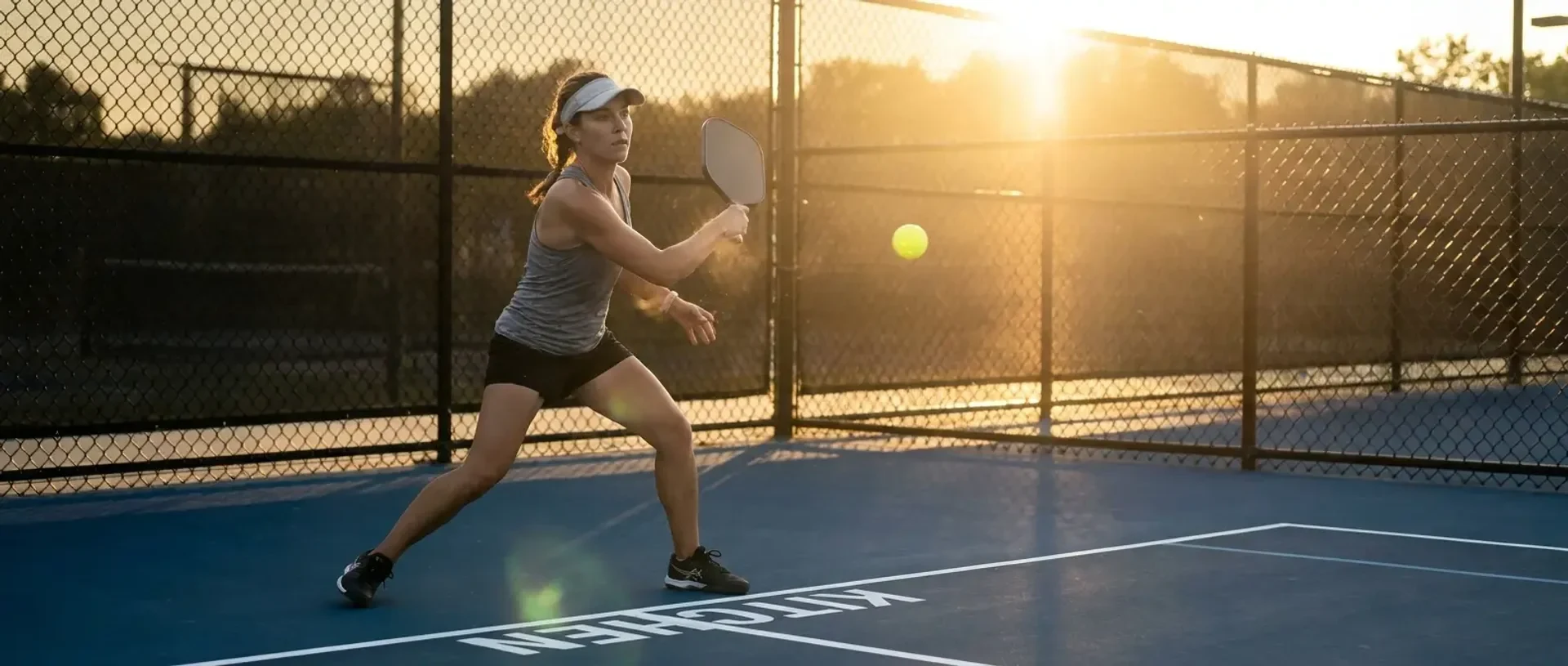
Speed up at the kitchen line when the ball is in your strike zone (sternum to shoulder), in front of your body, and your partner is set with their paddle up; reset when the ball is below the net, behind you, or your partner is still recovering. Most pop-ups at the kitchen come from speeding up on a ball that was begging to be reset.
Once both teams reach the kitchen, the rally turns into a dink-and-decide loop. Every ball you face, you pick one of three responses: dink, reset, or speed up. The speed-up is the most addictive because it feels like winning. It is also the highest-variance shot in the rally.
The good news is the right call is mechanical, and you can read it in the half second between the bounce and your contact.
This guide is a companion to our third-shot drive vs drop guide, picking up where that one ends: at the kitchen line, both teams set, the soft game running.
The five inputs that decide the shot
A speed-up is a counter-attack disguised as an attack. Each input below either gives you an opening or takes one away.
1. Ball height at contact
The biggest factor.
- Above the net, in your strike zone (sternum to shoulder): speed up is on the table.
- Net height, near your waist: situational, depends on stance and opponents.
- Below net: reset. Speeding up a low ball forces a lift, which is exactly the popup the other team is waiting for.
2. Ball position relative to your body
Contact has to be in front, paddle out. A ball you reach for, lunge at, or step around cannot be hit clean enough to win the hands battle that follows. Stretched speed-ups float, and floaters get countered to your feet.
3. Your stance
If you are set, balanced, and your weight is forward, the speed-up is live. Drifting back, lunging, or stuck on your heels: reset. A speed-up off a bad base is a feed.
4. Partner readiness
Speeding up starts a 2-on-2 reflex contest. If your partner is still walking up, scrambling from a reset, or holding their paddle low, the hands battle becomes 1-on-2 and you lose. Only swing when your partner is at the line, paddle at chest, eyes on the ball.
5. Opponents' grip
Look at their paddles in the half second before you swing. Up at chest, weight forward: ready to counter-punch. Dropped to the waist, weight on heels: not. Speed-ups are decided by whose paddle is up first; if theirs is already there, your shot gets blocked back to your feet.
The decision tree
Read top to bottom. Stop at the first answer that fits.
Where to aim the speed-up
Two targets work. One feels obvious and almost always loses.
Inside hip or sternum of the closer opponent. Jams them and forces a forehand-or-backhand decision under time pressure. Highest-percentage speed-up at every level above 3.5.
Dominant shoulder of a right-hander (the chicken wing). Forces a stiff, late backhand block. Cleanest single target for a confident speed-up.
Open court past the partner. Tempting, almost always loses. The partner sees the ball, the wide angle gives them time, and even a clean speed-up gets returned. Aim at bodies, not space.
Three rally examples
Each starts with both teams set at the kitchen line. Read them like film clips with stops.
Rally 1: Speed up at the body
- Crosscourt dink exchange, four shots in, forehand to forehand.
- Their fifth dink lands in the middle of your kitchen and bounces to chest height.
- You are set, paddle up, partner beside you with paddle up.
- Their paddles drift to their waists after the dink. Reset, not loaded.
- Call: speed up at the inside hip of the closer opponent. Heavy, flat, no lift.
- The block pops up to your partner. Partner finishes.
Rally 2: Reset on a low hook
- Backhand dink rally. The opponent has been pulling you wide.
- Their next dink hooks low and short, bouncing toward your kitchen line at ankle height.
- You are stretched onto your back foot. Paddle is low.
- Speeding up forces a lift over the net, straight into their strike zone.
- Call: reset. Soft backhand into their kitchen. Recover stance, paddle back up.
- Two dinks later, a popup at chest height and you finish with a clean speed-up.
Rally 3: The speed-up that should have been a dink
- Long dink rally, eight shots in.
- Their dink floats to your forehand at waist height. Above the net, but barely.
- You are set, partner is set. Both opponents at the line, paddles already at chest, eyes locked.
- You speed up cross-court at the open shoulder. The closer opponent gets a paddle on it.
- The ball comes back at your feet before you can drop your paddle.
- Lesson: the ball was attackable, but their paddles were already up. Without a real height advantage, you cannot win a hands battle into prepared paddles. The right call was another dink.
Common mistakes
Speeding up the first attackable ball you see. Just because you can does not mean you should. The right speed-up usually shows up between the seventh and twelfth dink of a rally, not the third.
Aiming at open court instead of bodies. Open-court speed-ups give the opponent angle and time. Body shots take both away.
Dropping the paddle after the speed-up. Paddle goes back to chest the instant the ball leaves your face. The next ball is coming fast.
Speeding up alone. If your partner is staring at their feet or backing up, your shot is uncovered. Wait until you are both set, then go.
Drill the read
Dink crosscourt with a partner for two minutes, then have them feed a "decide" ball at random heights for the next two. Call "speed up" or "reset" out loud before contact, then execute. Track your ratio. The skill you are training is judgment, not power. For the dink mechanics behind every reset, see our dinking strategy guide.
The honest summary
Speeding up is a tool, not a default. The fastest way to climb out of 3.5 is to speed up half as often and reset twice as well. You will lose fewer rallies to your own paddle, opponents will get bored and start lifting low balls, and the speed-ups you do hit will land on balls you can actually finish. Read the height, read the bodies, read your partner. Then trust the call.
For a side-by-side of how Briones, CJ Johnson, Tyson McGuffin, and Riley Newman each frame the speed-up choice (rec-level frequency, disguise, target selection), see our coach meta-analysis on speed-ups.
Frequently asked
Tap a question to expand.
When should I speed up at the kitchen line in pickleball?
Where should I aim a speed-up?
Is reset a defensive shot?
Why do my speed-ups keep getting countered?
How do I tell if my opponent is ready for a speed-up?
Read next
- Playing Well
Is stacking in pickleball snobby? No. It is optimization. Snobbery is a separate, fixable problem.
- Playing Well
The 4-week third-shot drop drill plan: 12 drills, measurable benchmarks, and the partner pattern that installs the shot for good
- Playing Well
The 4-week pickleball reset drill plan: 12 drills, measurable benchmarks, and the partner pattern that breaks the popup-attack-popup spiral

Reader notes on this guide
Sign in with your email to post. We do not run ad networks; comments are moderated for spam and abuse.
Loading comments...
Sign in to add a comment.