
Your first pickleball tournament: what to expect and how to prep
By My Pickleball Connect Team 7 min read
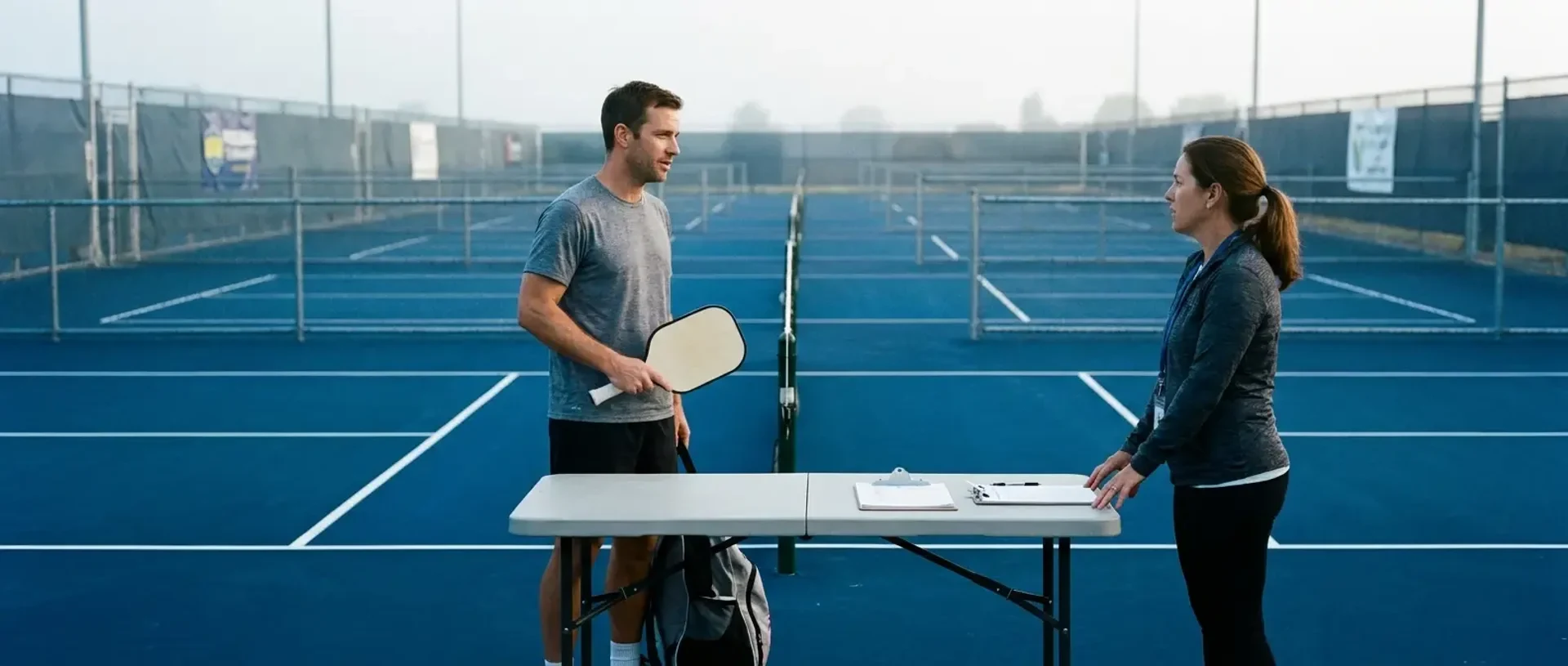
Your first pickleball tournament is going to feel strange. The warm-ups are short, the bracket board is confusing, and the matches start before you feel ready. That's normal. This guide walks through the parts nobody explains, so you show up prepared and play your best pickleball when it counts.
Picking the right event
Not every tournament is a good first tournament. You have three main paths.
Sanctioned USAP events are the serious ones. They use official rules, require a USAP membership, and your results count toward your rating. The fields are deep. If you're brand new to competition, these can be brutal unless you enter the 3.0 or 3.5 bracket and know what you're doing.
Local leagues and club tournaments are the best first stop. Entry fees are cheap, the vibe is social, and the brackets are smaller. You'll often get three or four matches in, even if you lose early. Check your local parks department, community center, or the Facebook group for your area.
PPA amateur brackets are a middle ground. The production value is high, the venues are nice, and the amateur divisions run alongside the pros. You'll pay more and travel further, but the experience is memorable. Pick one of these once you've done a local event or two.
Formats you'll run into
Most tournaments use one of three formats.
Single bracket is win or go home. You lose once and you're done. Fast, simple, and often unsatisfying for first timers who drove an hour to play one match.
Round robin means you play every other team in your pool. Everyone gets four or five matches regardless of record. This is the friendliest format for a first event.
Double elimination is the most common competitive format. You have to lose twice to be out. There's a winner's bracket and a loser's bracket (sometimes called the back draw). Expect long days with unpredictable gaps.
What to bring
Pack the night before. Your list:
- Two paddles. Strings break, faces crack, and borrowed paddles feel wrong.
- Court shoes. Running shoes slide on pickleball courts and can cause ankle injuries.
- Three balls. Most tournaments provide them, but bring your own for warm-ups.
- Athletic tape or KT tape. For blisters, a tweaked finger, or a knee that starts complaining in match three.
- Water. More than you think. A gallon jug is not overkill.
- Food. Bananas, peanut butter sandwiches, a bar or two, something salty. You could be there eight hours.
- Change of clothes. A dry shirt between matches is a real quality of life upgrade.
- A towel. For sweat, for sitting on grass, for wiping down the ball when the court is dewy.
Finding a partner and registering
Doubles is where most first timers start. Your partner matters. Play with someone whose DUPR rating is registered and close to yours. If one of you is a 3.0 and the other is a 4.0, USAP and most tournaments will require you to play up to the higher rating. You'll get crushed.
Register early. Brackets fill up weeks in advance, especially in the 3.0 and 3.5 divisions. Read the fine print on the event page so you know which rating system they use, what the refund policy is, and whether there's a minimum or maximum number of teams per bracket.
The day of
Arrive an hour before your first match. Check-in is a table with a clipboard or a laptop. You tell them your name, they check you off, sometimes they hand you a wristband. That's it.
Find the bracket board. It's either a big printed sheet on a wall or a screen showing live updates. Your match time is listed with a court number. Matches often run late by 20 to 40 minutes, so don't panic when you see your slot pass with no call.
Warm up before every match. Five to ten minutes of dinking, a few drives, and a handful of serves. If you have a long gap between matches (and you will), warm up again before you play. Cold legs lose first games.
Refereed vs self-refereed
Early rounds are almost always self-refereed. You call your own lines, keep your own score, and work out disputes like adults. Call the score loud and clear before every serve. Most arguments start with someone losing track.
Later rounds, quarterfinals and up, often get a referee. They'll handle the score and make line calls on your opponent's side. You still call your own side unless a line judge is assigned. Don't argue with the ref. If you think they got it wrong, ask politely and move on.
Rookie mistakes to avoid
A few things that trip up almost everyone their first time out.
Overpacking your bag so much you can't find anything. Keep it simple.
Under-hydrating. You'll drink twice as much as on a regular play day. Start drinking water the night before.
Serving to the wrong side. When you're nervous, you'll forget the score, forget which side you're on, or both. Slow down. Say the score out loud. Point at the correct receiver if you have to.
Not warming up between matches with long gaps. A 90 minute wait in the shade will stiffen you up. Walk around, hit a few balls, move your body before you step on.
Set your expectations right
Most first timers lose early. Some go 0-2 and are out by noon. That's fine. The point of your first tournament isn't to win. It's to learn what tournament pickleball feels like. The nerves, the pace, the waiting, the weird bounce of a new ball in unfamiliar wind. You bring that experience to your second tournament, and your third, and that's how you get good at competing.
Sign up for the next one before you leave the parking lot.
Frequently asked
Tap a question to expand.
Do I need a DUPR rating to enter a tournament?
How early should I arrive?
What happens if my partner cancels the week of?
Is it worth traveling for a first tournament?
Read next
- Playing Well
Is stacking in pickleball snobby? No. It is optimization. Snobbery is a separate, fixable problem.
- Playing Well
The 4-week third-shot drop drill plan: 12 drills, measurable benchmarks, and the partner pattern that installs the shot for good
- Playing Well
The 4-week pickleball reset drill plan: 12 drills, measurable benchmarks, and the partner pattern that breaks the popup-attack-popup spiral

Reader notes on this guide
Sign in with your email to post. We do not run ad networks; comments are moderated for spam and abuse.
Loading comments...
Sign in to add a comment.