
The 4-week solo pickleball practice plan, benchmarked
By My Pickleball Connect Team 13 min read
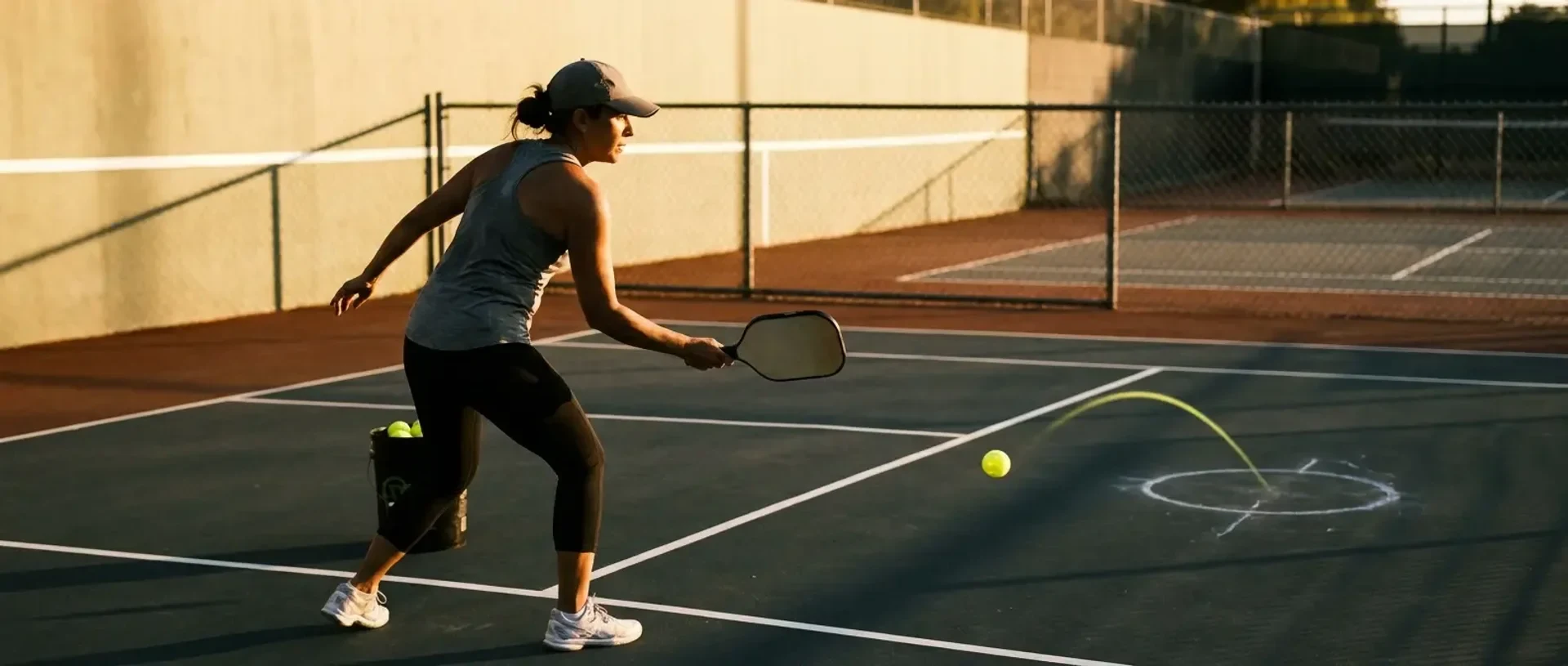
You can build a real pickleball game in four weeks of solo practice using a wall, a paddle, and 30 minutes a day, hitting measurable rep targets on dinks, drives, drops, and serves before you ever step on a court with another player.
Rec play feels like practice but it isn't. A two-hour session of open doubles gives you roughly 40 to 60 intentional contacts with the ball. Thirty minutes of focused solo work against a wall gives you 400 to 600.
That is a 10x density difference, and density is what builds the grooved, repeatable stroke you need to stop spraying balls at 3.0 and move into 3.5. Rec play is where you test skills. Solo work is where you build them.
This plan gives you twelve drills across four weeks, each with a setup, a rep target, and a benchmark you have to hit before you advance.
What you need
A flat wall at least 10 feet wide and 10 feet tall. A garage wall, a concrete handball wall, the back of a racquetball court, or the side of a building will all work.
One paddle. 30 outdoor pickleballs (a 50-ball pack runs under $35, and you will lose a few). Court shoes or clean tennis shoes.
Optional but useful: a roll of painter's tape to mark a net-height line at 34 inches on the wall, two cones or water bottles to mark a target zone, and a phone to film yourself. Total cost under $50 if you already own a paddle, under $120 if you don't.
Week 1: Foundation
Goal this week: clean contact and grip stability. You are not trying to hit hard, hit spin, or hit targets yet. You are training the paddle to meet the ball the same way every time. Most 3.0 players never fix this. If you do, you jump a full level.
Drill 1: Wall dink
Setup: Stand 7 feet from the wall, which is roughly the distance from the kitchen line to the net. Tape a line at 34 inches. Drop-feed a ball into the wall below the tape. Let it bounce once, dink it back under the tape, let it bounce, repeat.
Continental grip, paddle out in front, no wrist. Reps: 10 sets of 20 continuous dinks, alternating forehand and backhand. Benchmark: hit 20 in a row, three sets in a session, below the tape line, without moving your feet. If you cannot, repeat week one.
Drill 2: Continental grip serve
Setup: No wall needed. Find any flat 30-foot stretch. If you can't mark a real service box, put a towel 20 feet away as a rough landing target. Hold the paddle in a continental grip (shake-hands grip, paddle face vertical). Drop-serve the ball and swing low to high with a locked wrist. Reps: 50 serves per session, 25 to each side. Benchmark: 40 of 50 must land past the towel without double-faulting on the toss. Focus is contact, not placement.
Drill 3: Footwork ladder
Setup: Use chalk, tape, or an actual ladder on a flat surface. Mark 10 squares about 18 inches each. Run through three patterns: two feet in each box forward, lateral icky shuffle, one-foot hops.
After the ladder, finish with a split-step at the end: small hop, land feet shoulder-width, knees bent. Reps: 5 rounds of each pattern, 15 split-steps at the end. Benchmark: complete all three patterns cleanly three times in a row without tripping, and land every split-step balanced.
This is where almost everyone is sloppy. Do it anyway.
Week 2: Consistency
Goal this week: 50-rep streaks. Week one built a clean stroke. Week two makes it survive pressure. If you hit 30 dinks in a row and then the 31st goes into the net, you learned nothing on the first 30. The streak is the point.
Drill 4: Wall dink crosscourt rotation
Setup: Same 7-foot distance, same tape line. This time you are rotating: 10 forehand dinks, 10 backhand dinks, 10 alternating. Ball stays under the tape, stays in front of you. Reps: 5 rotations per session, 50 dinks per rotation.
Benchmark: one clean 50-rep streak under the tape in a single session. Deep breathing helps. If you tense up around 40, you are gripping too tight. Pressure three out of 10 on the grip scale, not seven.
Work on your dinking strategy the same way you work on your stroke.
Drill 5: Third-shot drop bounce-feed
Setup: Stand at a wall 15 feet back. Tape a line at 36 inches. Drop-feed a ball so it bounces to about knee height, then hit a soft shot that arcs up, crosses over the tape, and lands close to the base of the wall.
Watch the apex of the arc. It should peak before the tape line, not after. Reps: 50 drops per session. Benchmark: 35 of 50 land within 2 feet of the wall base and cross the tape at the peak of the arc, not on the way up.
Read the full mechanics in the third shot drop guide.
Drill 6: Serve target zones
Setup: Mark three zones on the ground 30 feet out, roughly the deep corners and center of a service box. Use cones, water bottles, or folded towels. Reps: 20 serves to the deep backhand zone, 20 to the deep forehand, 20 alternating. Benchmark: 14 of 20 within 2 feet of target on each zone. When you hit that, move the cones a foot deeper. Full serve mechanics live in the serving guide.
Week 3: Spin and pace
Goal this week: add topspin to your serve and brush-up to your dinks. You should not touch this week until week two benchmarks are met. Spin on a broken stroke just amplifies the break.
Drill 7: Topspin serve
Setup: Same serve position as drill 6. Start the paddle low, below the ball. Swing low to high and finish up by your ear. Imagine an equator across the ball and brush the back half from 6 o'clock to 12 o'clock. Reps: 50 serves per session.
Benchmark: 30 of 50 land deep (past the midpoint of a real service box) and kick forward on the bounce rather than skidding. Film yourself from the side. You should see the paddle finish higher than your shoulder.
Drill 8: Controlled drive
Setup: Stand 10 feet from the wall. Drop-feed and drive the ball at the wall with a compact swing. Contact out in front, wrist firm, follow-through short. The ball should hit the wall 3 to 4 feet above the ground and come back to you knee-high.
Reps: 4 sets of 25 drives per session, forehand only in the first two sets, backhand in the last two. Benchmark: 20 of 25 clean contacts where the ball returns into your strike zone without side-spin skidding. Power is not the goal; repeatable contact is.
Drill 9: Reset from baseline
Setup: Stand 14 feet from the wall. Drive the ball at the wall hard on purpose so it comes back fast at your chest. Absorb it with a soft grip (pressure three out of ten) and aim the return softly back toward the base of the wall.
You are fighting your reflex to swing. Reps: 30 resets per session. Benchmark: 20 of 30 return low, under 3 feet, without popping up. If you see the ball float, you gripped too hard. This is the shot that carries you through transition zone scrambles in real play.
Week 4: Game patterns
Goal this week: chain shots together like a real point. Single-shot drills produce single-shot players. Week four forces you to sequence: serve, return expectation, drop, step forward, dink. You will miss more this week than last week. That is the job.
Drill 10: Serve plus third-shot drop plus step in
Setup: Serve your 30-foot serve. After contact, take two shuffle steps toward the wall. Drop-feed the next ball as if it were a deep return, hit a third-shot drop. Take three more steps forward. You end the sequence 7 feet from the wall, where drill 1 started. Reps: 20 full sequences. Benchmark: 14 of 20 where all three parts land on target (serve deep, drop soft, feet at the kitchen).
Drill 11: Dink rally simulation
Setup: 7 feet from the wall, tape line at 34 inches. Start a rally and force yourself to change direction every fifth dink: five forehand, five backhand, five middle, five crosscourt angle. Reps: 5 rounds of 20 dinks, 100 total. Benchmark: one round of 50 with at least three direction changes, all below the tape. Direction changes are where dinks break down in real play. Practice the break.
Drill 12: Transition zone reset
Setup: Start 18 feet from the wall. Drive the ball hard. Reset the rebound. Step forward 2 feet. Drive again, reset again, step in again. Continue until you reach 7 feet. Reps: 10 full approaches per session. Benchmark: 7 of 10 approaches reach the kitchen line with every reset staying under 3 feet. This is the single most valuable pattern in pickleball below 4.0. Own it.
Daily structure: 30 minutes
Warmup (5 minutes): 20 air swings forehand, 20 air swings backhand, 50 shadow split-steps, 20 paddle flips in the hand. Drill block (20 minutes): run that day's drills in order. Do not skip to the drill you like.
Rotate by day: Monday, Wednesday, Friday hit all of the week's drills; Tuesday, Thursday focus on your worst drill only. Cooldown and mental review (5 minutes): stretch your wrist and shoulder, then film yourself doing one of the day's drills and watch the clip.
You will see three things on the replay you did not feel in the moment. Fix the easiest one tomorrow.
Benchmarks: when to repeat a week vs advance
- Hit all three weekly benchmarks at least twice in separate sessions before advancing.
- If you hit two out of three, spend two extra days on the missing drill, then advance.
- If you hit one out of three or fewer, repeat the full week. Zero shame. Most players need 5 to 6 weeks to finish the 4-week plan.
- Track reps on paper or in your phone notes. You will overestimate your consistency by 20 percent if you do not write it down.
- Film yourself once per week from the side. If your paddle path looks different from week one to week four, the work is working.
What this won't teach you
Four things. One, hands battles at the net. Quick-twitch exchanges against a live opponent are faster than any wall rebound and require partner drills. Two, communication in doubles. Who takes the middle, who covers the lob, when to stack. You cannot learn that solo. Three, reading opponents.
Shot selection based on body cues, paddle angle, and tendencies only develops against live humans across a range of styles. Four, match pressure. The feeling of a 9-9 side-out at 10-10 is a different nervous system than a wall drill. Solo practice complements live play. It does not replace it.
Use this plan to build the mechanics that free you to focus on the reads and the pressure when you are back in a real game. Drill alone two or three days a week. Play with partners the other days.
That is the ratio that produces 3.5 players in four weeks and 4.0 players in a season.
Frequently asked
Tap a question to expand.
How long does it really take to get better at pickleball through solo practice?
Do I need a ball machine to practice pickleball alone?
What if I don't have a wall I can hit against?
Can I skip a week if I feel ready?
Read next
- Playing Well
Is stacking in pickleball snobby? No. It is optimization. Snobbery is a separate, fixable problem.
- Playing Well
The 4-week third-shot drop drill plan: 12 drills, measurable benchmarks, and the partner pattern that installs the shot for good
- Playing Well
The 4-week pickleball reset drill plan: 12 drills, measurable benchmarks, and the partner pattern that breaks the popup-attack-popup spiral

Reader notes on this guide
Sign in with your email to post. We do not run ad networks; comments are moderated for spam and abuse.
Loading comments...
Sign in to add a comment.