
When to lob in pickleball: how to hit one, when it works, and when it backfires
By My Pickleball Connect Team 10 min read
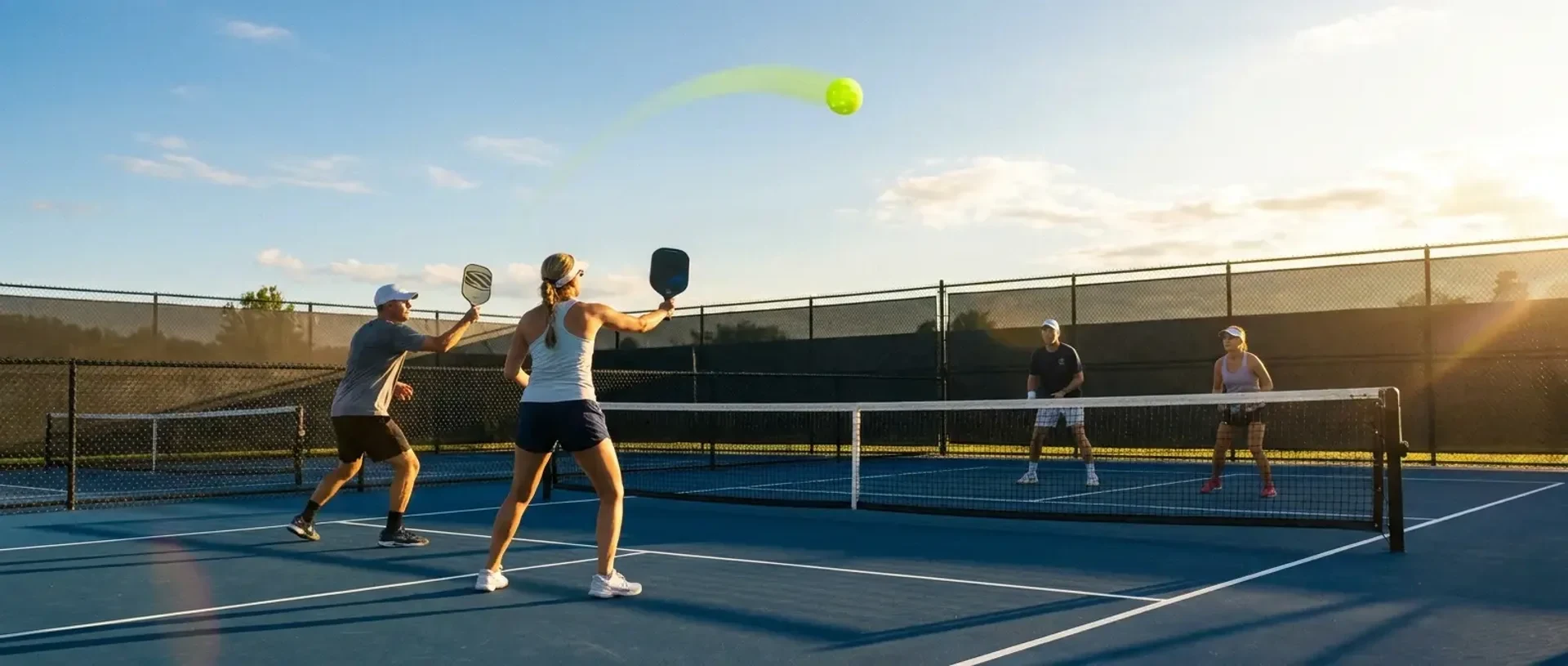
Lobs have a strange reputation in rec pickleball. Half the people you play with groan when they see one go up, and the other half rely on it as their only weapon when the dinking gets uncomfortable. Both groups are missing the point.
The lob is not a junk shot, but it is also not a get-out-of-jail-free card. It is a precision tool with a small target, a narrow window of opportunity, and a punishing failure mode when you guess wrong.
The reason most rec lobs feel cheap is not that the shot itself is cheap. It is that the player throwing it up has not earned the read, has not practiced the mechanics, and is using it as a panic button instead of a tactic.
If you watch enough high-level play, you will notice the pros barely lob at all. That is not because the shot is dead. It is because the players defending the kitchen line are tall, fast, and ready for it.
At 3.0 to 4.0 rec, almost none of those things are true, which means the lob is actually undervalued at the level most of us play. The trick is knowing when the green light is on, and being honest with yourself when it is not.
The two types of lobs
There are really only two lobs worth learning, and they are different shots that happen to share a name.
The offensive lob is hit from at or near the kitchen line, usually out of a dinking exchange.
Both teams are at the net, the ball is bouncing low in the kitchen, and you flip a controlled arc over your opponent's non-dominant shoulder so it lands a few feet inside the baseline. The trajectory is flatter than people think.
You are not trying to send the ball into the lights. You are trying to clear an outstretched paddle by three or four feet and bury it deep before they can turn and chase. Surprise is doing most of the work.
The defensive lob is hit from the baseline or transition zone when you are out of position, on the run, or pinned by a heavy drive.
Instead of trying to hit a perfect drop into the kitchen with bad balance, you push the ball high and deep over both opponents to buy yourself time to reset. This one has a steep, high arc. It is a survival shot, not a winner.
If your defensive lob lands deep enough that they have to back off the kitchen line to play it, you have done your job. You did not win the point. You just kept it alive and bought a few seconds to get your feet back under you.
Mixing these up is where rec players get burned. Trying to hit a flat offensive lob from the baseline puts the ball directly into an overhead. Trying to float a high defensive lob from the kitchen line gives the other team an eternity to camp under it.
Mechanics of a good lob
The stroke for a clean offensive lob looks almost identical to a dink right up until contact. Same compact backswing, same low-to-high path, same stable wrist. The difference is the paddle face is slightly more open and the follow-through is longer and more pronounced. You are pushing through the ball, not flicking it.
Contact happens out in front of your body, not next to your hip. Letting the ball drift back kills your control of the paddle angle, and you end up either popping it straight up or flat-lining it into the net. Keep your knees bent and your weight balanced. The lift comes from your legs and shoulder turn, not a wristy scoop.
Target depth is the part most rec players butcher. The landing zone is roughly the last three feet inside the baseline. Anything shorter is an overhead waiting to happen. The arc clears your opponent's reach by three to four feet, no more. A monster moonball gives them all the time in the world to set up. You want a flatter, faster offensive lob that gets there before their feet do.
For the defensive version, open the face more, follow through almost vertically, and aim higher. You need height to give yourself recovery time. Place it over the backhand shoulder if you can. Anything that lands within a couple feet of the baseline gets the job done.
When to lob (the green-light situations)
The clearest tell is opponents leaning hard into the kitchen line during a dink rally. Their weight is on their toes, their paddle is low, their eyes are tracking the ball down. That is when a disguised lob over the shoulder is almost a free point.
Other green lights worth recognizing:
- An opponent with a slow or weak overhead. You will spot this within the first few points.
- One or both opponents are noticeably shorter, or playing on aging legs that do not love backpedaling.
- Sun or stadium lights directly behind your lob target. Even good athletes lose balls in glare.
- A long deep dink rally where someone is creeping further over the kitchen to keep reaching.
- You have a clean, balanced contact at the kitchen and your opponent is recovering from a wide ball.
- Wind at your back, not in your face. A tailwind makes the lob land softer and deeper.
The thread connecting all of these is opportunity, not desperation. You are choosing the lob because the geometry is in your favor, not because you are afraid of the next dink.
When NOT to lob
Most rec lobs are bad because the player ignored at least one of these.
- You are off balance. Off-balance lobs from the kitchen go up, not over. If your feet are not set, hit the dink and live to fight.
- Both opponents are at the line and ready. No surprise, no advantage. Two people splitting the court will run almost any lob down.
- You are playing a tall, athletic opponent with a real overhead. Lobs to a 6'2 player who can move are donations.
- The wind is in your face. The ball will hang and shorten. You are gift-wrapping a smash.
- You just lobbed last point. The element of surprise is the whole shot. Telegraph it twice and the third one comes back as a winner.
- You cannot control the height. If your practice lobs land at random depths, do not pull this trigger in a game.
Reading the lob from your opponent
Defending the lob is a partner skill. The instant you read one going up, the player it is sailing over should call it ('mine' or 'switch') and drop step, not backpedal. Backpedaling is how people sprain ankles and crack heads on this shot.
If the lob is short and you can get under it with your paddle up around shoulder height, you are taking it out of the air as an overhead. Closed stance, non-paddle hand pointing up at the ball to track it, contact out in front and high. You do not need to crush it. Eighty percent power placed at feet wins the point.
If it is going to clear you, let it bounce, chase it down with a drop step and a turn, and reset with a high defensive lob of your own. Do not try to hit a winner from your own baseline. The team that re-establishes at the kitchen first wins the next exchange almost every time.
Drills to build a real lob
The lob does not get better in games. It gets better with reps in a dead-ball setting where you can groove the contact and the depth.
Drill 1: Cone target lob. Place two cones or paddle covers about three feet inside the baseline on the deuce side, two more on the ad side. You stand at your kitchen line, partner stands at theirs, and dink cooperatively. On a count you choose silently, lob over your partner's backhand shoulder toward the cones. Reset, repeat. Hit 25 to each side. Score yourself: a make is anything that clears the partner's reach and lands in the marked zone.
Drill 2: Defensive lob from the baseline. Partner feeds you a hard drive from the kitchen line. You hit a defensive lob aimed at the last three feet of the court, then sprint to your kitchen line. Reset and repeat 20 times. The success metric is whether your lob landed in the back third and you got to your line before the next ball would have arrived.
Drill 3: Disguise the lob in a live dink rally. Cooperative dinking with a partner, both at the kitchen line. Every fifth or sixth ball, you lob without changing your setup. Partner's job is to call 'lob' the moment they read it. Do 3 sets of 10 lobs. The goal is to delay their call by half a second by keeping your shoulders, paddle height, and stance identical until contact.
Hit those three drills for two or three sessions and your lob stops being a coin flip. That is when it becomes a tactic instead of a tantrum.
For a side-by-side of how Briones, CJ Johnson, Tyson McGuffin, and PrimeTime each frame the lob (offensive vs defensive, the disguise question, and CJ's under-discussed call to lob less at the rec level), see our coach meta-analysis on the lob.
Frequently asked
Tap a question to expand.
Is lobbing in rec pickleball bad etiquette?
How high should an offensive lob actually go?
Why do the pros barely lob?
Should I lob off a third shot drop attempt?
Read next
- Playing Well
Is stacking in pickleball snobby? No. It is optimization. Snobbery is a separate, fixable problem.
- Playing Well
The 4-week third-shot drop drill plan: 12 drills, measurable benchmarks, and the partner pattern that installs the shot for good
- Playing Well
The 4-week pickleball reset drill plan: 12 drills, measurable benchmarks, and the partner pattern that breaks the popup-attack-popup spiral

Reader notes on this guide
Sign in with your email to post. We do not run ad networks; comments are moderated for spam and abuse.
Loading comments...
Sign in to add a comment.