
Pickleball injuries: what the data actually shows and how to prevent them
By My Pickleball Connect Team 8 min read Last reviewed
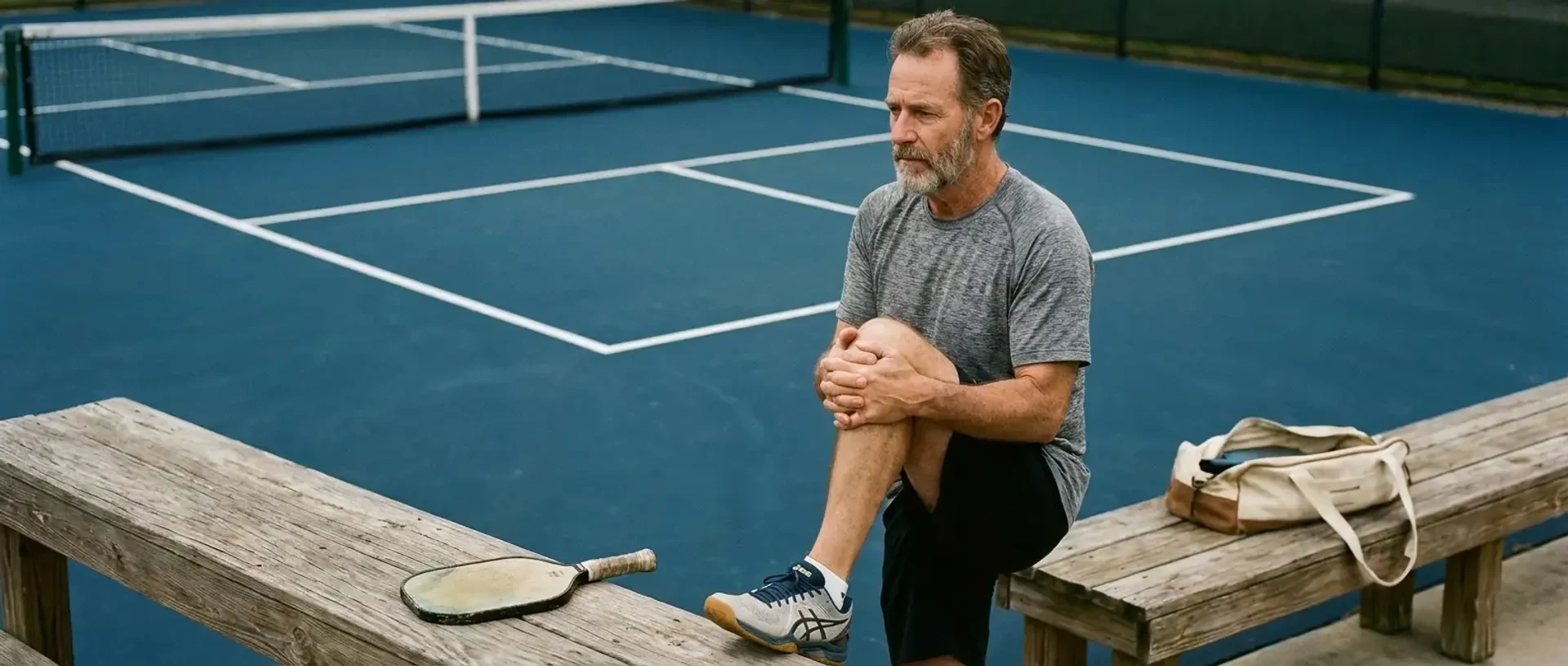
Pickleball is the safest racket sport you can play right up until the moment you tear your Achilles. The injury data is more textured than the alarmist coverage suggests, and worse than the boosters claim, especially for players over 50 who came from tennis or running and assumed the move would be easy on their joints. This guide walks through what emergency-room data actually shows, the four injuries that show up most often, and seven prevention practices supported by sports-medicine guidance.
What the data actually shows
The cleanest peer-reviewed look at pickleball injuries is Forrester (2020) in the Journal of Emergency Medicine, which mined the National Electronic Injury Surveillance System (NEISS) maintained by the U.S.
Consumer Product Safety Commission for the years 2001 through 2017.[1] Forrester's NEISS-based study estimated about 19,000 pickleball-related ED visits across the 2001 to 2017 study window, with sprains, strains, and fractures dominating the injury types and players over 50 accounting for almost all the volume.[1] The most-injured body region was the lower extremity (especially ankle), followed by the upper extremity (especially wrist), with head injuries from falls a distant but persistent third.[1]
The trend has tracked the sport's rapid growth since: same lower-extremity sprains, same falls, same older-adult demographic, in many more bodies.
The 2019 clinical summary in Missouri Medicine by Greiner remains the most useful in-print pattern-of-injury overview: pickleball produces the same overuse and acute injuries as tennis, with a higher fall rate because the small court forces repeated rapid changes of direction in players whose joints are no longer young.[2] The American Academy of Orthopaedic Surgeons reaches the same conclusion in its public OrthoInfo guidance: most pickleball injuries are preventable, and the injuries that send people to the OR are usually falls.[3]
The four injuries you actually need to know
1. Lateral ankle sprain
The single most common acute injury, and the top of the NEISS lower-extremity bucket.[1] Pickleball moves players forward and back and side to side in tight bursts on a hard surface, often in tennis or running shoes that lack lateral support. A planted foot turning under is the textbook mechanism. Recovery is usually weeks, not months, but a poorly rehabbed first sprain dramatically raises the odds of a second.[2]
2. Calf strain ("pickleball pop")
Players over 40 frequently report a sudden, painful sensation of being kicked in the calf during a sprint to the kitchen. That is usually a medial gastrocnemius strain. Greiner notes it as one of the most stereotyped pickleball injuries because the kinetic chain (sudden eccentric load on a cold calf in an aging tendon) maps almost exactly onto the population of new players.[2]
3. Rotator cuff impingement and tears
Overhead serves and put-aways, repeated thousands of times across a season, drive the same shoulder pathology you see in tennis: subacromial impingement, rotator cuff tendinopathy, and partial-thickness tears.[2][3] AAOS specifically flags overhead repetition as a primary mechanism in racket-sport shoulder injuries.[3]
4. Lateral epicondylitis ("pickleball elbow")
The same overuse pattern that produces tennis elbow produces pickleball elbow. Repeated wrist extension and snapping forearm motion at contact, particularly with a heavy or improperly gripped paddle, irritates the common extensor tendon at the lateral epicondyle.[2] AAOS guidance estimates that about 1 to 3 percent of the general adult population experiences lateral epicondylitis at some point, and racket-sport players sit disproportionately in that group.[3]
Seven prevention practices that have evidence behind them
- Warm up dynamically, not statically. Five to ten minutes of dynamic mobility (leg swings, lateral lunges, light jogging) before play has been shown to reduce lower-extremity injury rates in court-sport athletes in a meta-analysis of injury-prevention programs.[4] Static stretching before play does not reduce injury and may slightly reduce muscle power.[4]
- Wear court shoes, not running shoes. Running shoes are designed for forward gait, with elevated heels and flexible uppers. Court shoes have a wider base, lower heel, and stiffer sides for the lateral cuts pickleball demands. AAOS specifically recommends court shoes for racket-sport players to reduce ankle sprain risk.[3]
- Train your calves eccentrically. A heel-drop protocol of three sets of 15 reps with a slow eccentric phase, twice a day, originally described by Alfredson in the American Journal of Sports Medicine in 1998, has been a standard tool in Achilles tendinopathy prevention and rehab ever since.[5] Strong, durable calves resist the eccentric load that produces the pop.
- Lower the volume, not the intensity, in your first eight weeks. The injury curve in racket-sport newcomers is heavily front-loaded. Greiner argues for a gradual buildup: start with shorter, less frequent sessions and add volume in stages rather than playing every day from week one.[2]
- Strengthen the rotator cuff before you need to. External rotation work with a band, scapular stabilization (rows, Y-T-W raises), and serratus activation reduce shoulder injury risk in overhead-sport athletes per AAOS rehabilitation guidance.[3]
- Wear eye protection if you play often. Pickleball balls move fast at close range, and eye injuries (corneal abrasions, hyphemas, retinal detachments) are a documented risk in racket sports per AAOS.[3] Polycarbonate sport goggles cost about $30 and prevent the entire category.
- Fall correctly when you have to. Most catastrophic pickleball injuries are wrist fractures from a backwards fall on an outstretched hand chasing a lob, which is consistent with the NEISS upper-extremity pattern.[1] AAOS recommends turning a fall into a controlled tuck-and-roll if possible, and avoid backpedaling. Drop step, turn, and run instead.[3]
When to see a PT vs. ride it out
The honest rule, supported by AAOS sports-medicine guidance: see a physical therapist or sports physician if pain persists past 7 days, if you cannot bear weight, if you heard a pop, or if you have visible swelling that does not subside overnight.[3] Mild soreness 24 to 48 hours after a hard session is normal and does not require treatment.
Pain that does not improve, or that gets worse with rest, does.
The dangerous middle ground is the four-to-six week window of "I'll just play through it," where a small calf strain can become a full tear and a rotator cuff tendinopathy can become a partial-thickness tear that needs surgical repair.
Greiner specifically flags chronic-to-acute conversion in racket sports: untreated tendinopathies tend to get worse with continued play, not better.[2]
If you are over 50, played tennis or another racket sport before, or have any history of joint surgery or chronic pain, get a baseline movement screen with a sports PT before ramping up. Our pickleball for seniors guide covers gear and joint considerations specific to the 60+ player.
The warmup and stretching guide covers the calf protocol and dynamic mobility routine that sports-medicine sources recommend, and best pickleball shoes for 2026 covers the footwear half of injury prevention. The training programs hub indexes the structured multi-week programs (mobility, bodyweight strength, knee rehab, tennis elbow comeback, return-to-play) that turn the prevention practices above into actual habits. Thirty minutes with a clinician identifies the asymmetries that produce the injuries above.
This article is for general informational purposes only and is not medical advice. If you are injured or in pain, see a qualified clinician.
References
- Forrester MB. Pickleball-Related Injuries Treated in Emergency Departments. J Emerg Med. 2020;58(2):275-279. · NEISS analysis, 2001 to 2017
- Greiner N. Pickleball: Injury Considerations in an Increasingly Popular Sport. Mo Med. 2019;116(6):488-491. · Clinical pattern-of-injury overview
- American Academy of Orthopaedic Surgeons, OrthoInfo (sports injury and prevention guidance) · Major medical body guidance
- Soomro N, Sanders R, Hackett D, et al. The Efficacy of Injury Prevention Programs in Adolescent Team Sports: A Meta-analysis. Am J Sports Med. 2016. · Dynamic warm-up evidence base
- Alfredson H, Pietilä T, Jonsson P, Lorentzon R. Heavy-load eccentric calf muscle training for the treatment of chronic Achilles tendinosis. Am J Sports Med. 1998;26(3):360-366. · Original Alfredson eccentric calf protocol
Frequently asked
Tap a question to expand.
What is the most common pickleball injury?
Are pickleball injuries actually increasing?
How long should I rest a calf strain before playing again?
Do I really need court shoes for pickleball?
Read next
- Health
Pickleball knee pain: the easy 2-minute fix that worked for me (after foam rolling, ATG, and strengthening did not)
- Health
The 8-week pickleball shoulder comeback program: rotator cuff strengthening, the sleeper stretch, and the serve mechanics that prevent re-injury
- Health
The 8-week pickleball back comeback program: McGill Big 3, hip mobility, and the twist-and-lunge mechanics that prevent re-injury

Reader notes on this guide
Sign in with your email to post. We do not run ad networks; comments are moderated for spam and abuse.
Loading comments...
Sign in to add a comment.