
Pickleball court dimensions: every number, plus backyard conversion math
By My Pickleball Connect Team 9 min read Last reviewed
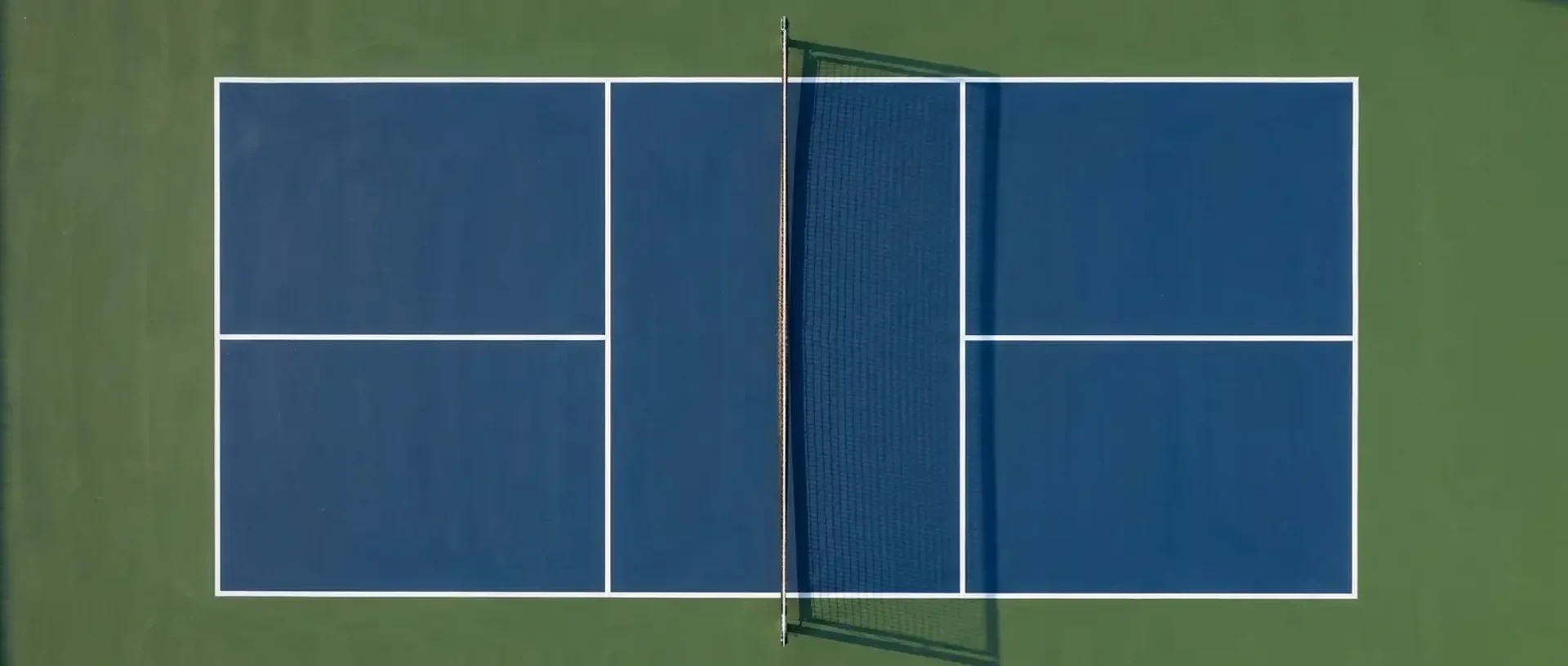
A regulation pickleball court is 20 feet wide by 44 feet long, the same size as a doubles badminton court, with a 7-foot non-volley zone on each side of a net that stands 36 inches at the posts and 34 inches at the center.
Those are the headline numbers. The rest of this page is a reference for every other measurement a player, builder, or backyard owner actually needs: line widths, service box size, total recommended footprint, net post spacing, surface spec, and the math for squeezing a court onto a driveway.
All numbers below match the 2026 USA Pickleball rulebook and the USA Pickleball court construction guide.
The numbers, in one place
- Court playing surface: 20 feet wide by 44 feet long (6.10 m by 13.41 m), same for singles and doubles.
- Non-volley zone (kitchen) depth: 7 feet from the net on each side, running the full 20-foot width.
- Baseline to non-volley zone line: 15 feet.
- Service areas: Two boxes on each side, each 10 feet wide by 15 feet long, split by the centerline.
- Centerline: Runs from the non-volley zone line to the baseline, dividing the two service areas.
- Net height at the posts: 36 inches.
- Net height at the center: 34 inches.
- Net posts: 22 feet apart (one foot outside each sideline), maximum 3 inches in diameter.
- Net length: At least 21 feet 9 inches, minimum 30 inches tall, with a 2-inch white tape along the top cord.
- Line width: 2 inches, measured to the outside edge, in a color that contrasts with the surface.
- Minimum recommended total play area: 30 feet by 60 feet per court.
- Preferred total play area: 34 feet by 64 feet per court.
- Tournament total play area: 40 feet by 64 feet is common for sanctioned events.
- Wheelchair court recommendation: 44 feet by 74 feet of total play area.
Court vs total footprint
The 20 by 44 court is the part you paint. The 30 by 60 or 34 by 64 number is the space around it: run-out behind each baseline, side clearance outside each sideline, and room for a backstop or fence. A court with no run-out is technically legal but actively dangerous. Players backpedal on lobs, lunge for sideline shots, and need a buffer that is not a chain-link fence.
The 30 by 60 minimum gives 5 feet of side buffer and 8 feet of run-out behind each baseline. The 34 by 64 preferred size pushes that to 7 feet on the sides and 10 feet behind. Competitive play benefits from the extra run-out because defensive lobs force players 4 to 6 feet behind the baseline.
Fencing guidance from the USA Pickleball construction guide calls for a 10-foot minimum backstop height behind each baseline, with side fencing at 3 feet minimum or matching the backstop height for the first 30 feet. For indoor facilities, ceiling clearance should be 18 to 20 feet at minimum, with 20 to 24 feet preferred so a hard lob does not smack a light fixture.
Pickleball court vs tennis vs badminton
| Spec | Pickleball | Tennis (doubles) | Badminton (doubles) |
|---|---|---|---|
| Court length | 44 ft | 78 ft | 44 ft |
| Court width | 20 ft | 36 ft | 20 ft |
| Net height at posts | 36 in | 42 in | 61 in |
| Net height at center | 34 in | 36 in | 60 in |
| Non-volley / service constraint | 7 ft kitchen off the net | 21 ft service box from net | 6.5 ft short service line |
| Total recommended footprint | 30 by 60 ft | 60 by 120 ft | 30 by 60 ft |
Pickleball and doubles badminton share an identical outer rectangle. That is not a coincidence: pickleball was invented on a badminton court on Bainbridge Island in 1965. A tennis court is roughly 1.75 times longer and 1.8 times wider than a pickleball court, which is why one tennis court reliably lines out to four pickleball courts.
Can you fit a court in your backyard?
The 30-foot width is almost always the binding constraint. Most residential backyards and driveways can find 60 feet of length, but 30 feet of clear width, with no shed, fence, or drainage slope in the way, is the number to measure first.
The rough tiers, based on what USA Pickleball construction partners build most often:
- 34 by 64 ft: Preferred. Full run-out, comfortable for 4.0+ play, fits a 10-foot back fence without crowding.
- 30 by 60 ft: Minimum recommended. Fine for rec play, dinking practice, and kids.
- 28 by 60 ft: Works with compromise. You lose a foot of side clearance on each edge, which matters more for lobbed returns than for most rec shots. Wall or fence padding is worth adding.
- 24 by 50 ft: Not a regulation court. You can paint the 20 by 44 lines and play, but you will hit fences on most serves and lobs. Better for a practice wall or mini-court drills than real games.
Driveway conversions follow the same math. A two-car driveway is usually 18 to 20 feet wide, which is not enough: the court itself is 20 feet, and you need clearance on top of that. A three-car driveway or a driveway plus adjacent lawn gets you to 30 feet.
Length is rarely the problem since most driveways run 40 to 60 feet. Slope is the problem. Anything over a 1% grade starts to change the bounce, and over 2% is unplayable without resurfacing.
Net specs and surface
Net posts sit 22 feet apart, one foot outside each sideline, and cannot exceed 3 inches in diameter. The net itself is at least 21 feet 9 inches long and at least 30 inches tall, hung so it measures 36 inches at the posts and 34 inches at center. A 2-inch white tape covers the top cord. Mesh size has to be small enough that a pickleball cannot pass through.
Outdoor surface standard is a 100% acrylic coating system applied over asphalt or post-tensioned concrete. Acrylic is what you see on public and club courts: it gives a consistent bounce, handles UV, and takes line paint cleanly. Concrete is more expensive up front and cracks less; asphalt is cheaper and resurfaces more often. Raw concrete or asphalt plays faster and harder on the feet than a coated surface.
Indoor courts typically run on a cushioned acrylic over concrete, a modular snap-together tile system, or hardwood. Gym floors painted with pickleball lines are common but play noticeably slicker than an outdoor acrylic court, which is one reason indoor balls are built differently.
Indoor vs outdoor court differences
The lines are identical. What changes is the surface, the ball, and the air. Indoor courts run on smoother flooring and use a softer, larger-holed ball. Outdoor courts use a harder, smaller-holed ball that holds up better in wind. For the full breakdown, see our indoor vs outdoor pickleball guide.
Lining a multi-use court
Overlaying pickleball on an existing tennis court is the most common conversion. One tennis court accommodates four pickleball courts laid out perpendicular to the net, each with its own portable net. The new lines should be a distinct color from the tennis lines: blue or green pickleball lines on a green or red tennis surface is the standard.
For temporary conversions, vinyl or polyester tape rated for court surfaces holds for weeks of play and peels cleanly. Permanent conversions use standard court paint at 2 inches wide, same spec as a dedicated court. The non-volley zone line is the most important line to get right because players reference it on almost every point; if you are taping only one line, tape the kitchen.
If you are sharing a court with tennis long-term, expect some confusion in the first week. Pickleball lines that run close to tennis lines can be visually busy, but players adjust fast.
If you are new to the lines and zones themselves, our picture-first pickleball dictionary walks through each one with a top-down diagram. And if you are pricing out a real backyard build, the 2026 backyard cost breakdown covers what every line item actually runs.
References
Frequently asked
Tap a question to expand.

Reader notes on this guide
Sign in with your email to post. We do not run ad networks; comments are moderated for spam and abuse.
Loading comments...
Sign in to add a comment.