
How to play with lower-level players in pickleball
By My Pickleball Connect Team 8 min read
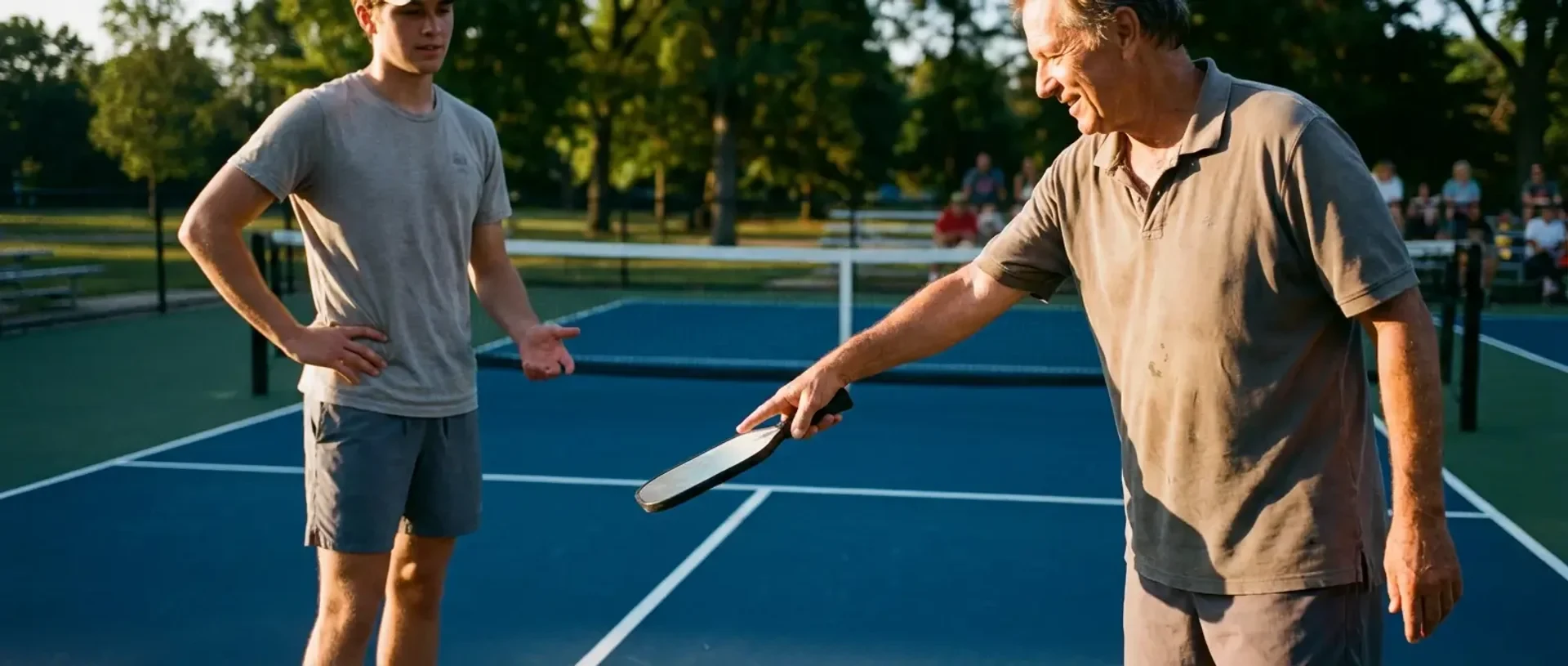
Open play rotates everyone together. A 4.0 ends up with two 3.0s and a beginner. The rotation guarantees this kind of mismatch, and stronger players get the question a lot: how do you play a real game without either crushing people or playing so soft you pick up bad habits.
Why mixed-level play is normal
Open play is built on rotation. Four people come on, four come off, paddles get shuffled, and the next group forms from whoever is in line. The math means you'll play with people above and below your level constantly.
It also has a practical upside for the stronger player. Mixed games force you to solve problems you don't face against equals. You cover more court. You hit shots that set your partner up rather than shots that finish points yourself. You manage tempo. None of that is wasted practice.
Take pace off, and put it back on for the right ball
Pace control is the main habit. Take real pace off when a flat drive would overwhelm the player in front of you, and put real pace on when they can handle it. A flat 70 percent drive into a 3.0 backhand isn't useful for either of you, they can't return it cleanly, and you don't get to practice anything you can't already do.
Spread the ball around
In a tournament you hunt the weaker player. In rec you spread the ball around. That doesn't mean avoiding the weaker opponent entirely, that's its own problem. It means you don't park every shot in the same body. Hit to the stronger player on returns of serve. Engage them in the dink rally. Let the weaker player face challenges they can actually solve.
Use the game as drilling time
Pick a personal goal for the game and chase it. Five third-shot drops in a row that land in the kitchen. Every return deep past the service line. No unforced errors on the backhand side. The score ticks along, you stay engaged, and you leave having worked on something specific.
Don't body-bag a beginner
A put-away from six feet at a nervous beginner ends the point but the game stops being fun for everyone, including you. Same goes for the lob hunter who sees a player with bad mobility and goes overhead every other point, or the speed-up artist who treats every dink rally with a 3.0 like a tournament reset opportunity. Save those shots for matches where everyone signed up to be tested.
Drills you can run inside mixed-level games
Stop playing for the score and start playing for a target. A few specific drills you can run without anyone else noticing:
- Aim for spots, not pace. Pick a target zone the size of a paddle face. Outside foot of the returner, deep middle on the third, sideline on the dink. Score yourself on placement, not on whether the point ended.
- Work a specific shot all game. Drop every third. Drive every third. Backhand return only. Crosscourt dinks only. The constraint forces reps you'd skip in an open game.
- Practice patience. Set a rule that you won't speed up the first attackable ball, only the second one. The second one is usually higher and easier anyway.
- Reset volume. Count how many resets you hit from the transition zone in a session. Growing that number is a real skill goal.
- Off-hand or weaker-side reps. Stand in the ad court if you normally play deuce. Hit your backhand dink even when forehand was available.
When the level gap is too wide
Sometimes it isn't a 4.0 and a 3.0, it's a 4.0 and a true beginner who's been playing for two weeks. A friendly short game is fine, and then pointing them toward a beginner clinic or designated beginner night is the most useful thing you can do. Most clubs run them.
If you're running open play and the gap is constantly that wide, the fix is structural. Skill-based time blocks, separate beginner courts, posted ratings on certain nights, paddle-stack rules that mix levels intentionally for one game and let levels match for the next.
If you're the lower-level player
Show up ready to compete, not to apologize. Self-deprecating talk before every point gets old fast. Call your own lines clean and quick. Hustle for balls you might not get to. If a stronger player offers a tip and you asked for it, try it for a few points. If you didn't ask for it, a friendly redirect is fine.
And don't treat the game as a free lesson. The stronger player came to play, same as you.
Frequently asked
Tap a question to expand.
Is it rude to politely decline a game with much weaker players?
Should I give coaching tips during the game?
How do I keep my edge if half my rec play is with weaker players?
What if my partner is the much weaker player and we are losing badly?
Read next
- Playing Well
Is stacking in pickleball snobby? No. It is optimization. Snobbery is a separate, fixable problem.
- Playing Well
The 4-week third-shot drop drill plan: 12 drills, measurable benchmarks, and the partner pattern that installs the shot for good
- Playing Well
The 4-week pickleball reset drill plan: 12 drills, measurable benchmarks, and the partner pattern that breaks the popup-attack-popup spiral

Reader notes on this guide
Sign in with your email to post. We do not run ad networks; comments are moderated for spam and abuse.
Loading comments...
Sign in to add a comment.