
How to go pro in pickleball: DUPR thresholds, MLP, PPA, and what pros actually earn
By My Pickleball Connect Team 11 min read Last reviewed
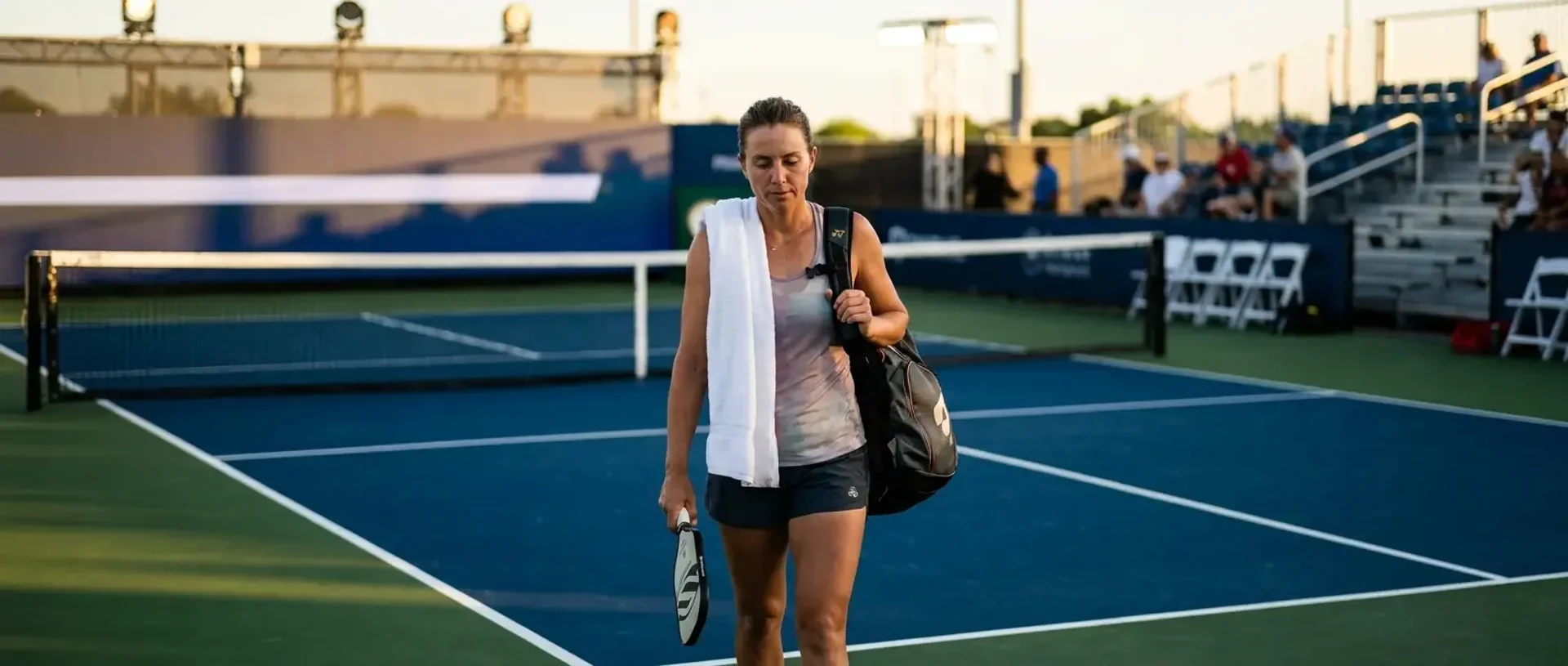
Walk into any decent rec session and you will hear someone say they could go pro if they just trained full time. The math says otherwise.
DUPR tracks more than 1.5 million rated players globally, and the number of athletes who actually pay rent from playing pickleball is closer to 50 than 500. The PPA Tour fields roughly 100 to 150 contracted pros at any given event.
MLP fields 16 Premier teams of six players each, which puts the entire top-tier league at 96 roster spots.
Most of the people earning real money inside that group are the same names you see on the broadcast every week, and the gap between the bottom of that bracket and the top of the rec ladder is much wider than it looks.
The DUPR ceiling
DUPR uses a 2.0 to 8.0 scale where every full point represents a meaningful jump. The official tier descriptions are simple. 2.00 to 2.99 is beginner. 3.00 to 3.99 is intermediate. 4.00 to 4.99 is advanced. 5.00 to 8.00 is bundled together as elite and professional, which is where the conversation about going pro actually lives.
What does each tier feel like in match results? A 4.0 player can rally consistently, hold their third drop together most of the time, and beat anyone below them roughly nine out of ten games.
A 4.5 starts to add reliable spin, can defend speed-ups at the kitchen line, and reads stacks. A 5.0 has tournament-tested mechanics under pressure, including a serve and return that produce predictable advantages. A 5.5 plays clean against pros in a friendly setting and wins regional opens.
A 6.0+ is functionally a tour-quality player.
DUPR has not published an official percentile distribution, but the shape of the player base is well understood. The majority of rated players sit between 3.0 and 4.0. The 4.5 to 4.99 band is already a tiny minority of the pool.
The 5.0+ band is where amateurs run out of headroom and stop climbing through normal rec play. The 6.0+ band is essentially a few hundred people on Earth. To put that in perspective, Anna Leigh Waters and Ben Johns sit above 6.5 in doubles.
A self-rated 5.0 amateur and a 6.0 contracted pro are not in the same sport in any practical sense. The pro will hit shots the amateur has never seen at game speed, and the score will reflect it.
How the tours actually work
There are three structures worth knowing. The PPA Tour and MLP both sit under the United Pickleball Association umbrella now. The APP runs separately. They behave differently and pay differently.
PPA Tour
The PPA runs 25+ tournaments a year across five tiers. Worlds events award 3,000 ranking points to a winner. Slams award 2,000. Cups give 1,500, Opens 1,000, and Challengers 125 to 500. Anyone can enter the Pro Qualifier draw at most stops, and the bracket winner advances into the main draw against contracted pros.
That sounds open, but the qualifier pool is stacked with players who train full time and chase points. Beating that field as an unsponsored player is a long shot, and the prize money on offer is small until you reach the second weekend of a Slam.
Sample 2026 payouts at Slam-level events: $90,000 for a doubles championship, $76,000 for mixed doubles, $23,000 for singles. That is for the winning team or player, not per partner in some cases, and it splits between the two players in doubles.
Contracted players get more than prize money. Gold contracts require a two-year commitment, attendance at 20 PPA events plus all four Majors, and full participation in MLP.
In return, Gold players earn double the prize money table compared to non-Gold players at both PPA and MLP events, and their entry fees are comped. Silver contracts demand five PPA events, all six MLP events, and no tour exclusivity.
The PPA Challenger Series, run with JOOLA, hands a $10,000 purse per stop and is restricted to players outside the PPA top 20, which makes it the most realistic on-ramp for someone trying to break in.
MLP
Major League Pickleball is a team league with 16 Premier-level franchises. Each team carries a six-player roster, three men and three women. Teams play head-to-head in a format that mixes mixed doubles, gender doubles, and a Dreambreaker singles tiebreaker.
The draft does not work like the NFL. MLP uses dynamic bidding with no spending cap. Teams bid Draft Points to claim selection slots, then pick from the eligible UPA player pool.
Minimums start at 10,000 Draft Points for early picks and step down to 1,000 for the final 32 picks. To retain a player from the prior year, a team has to pay half of that player's prior Draft Points, in real dollars, to MLP.
When Carolina kept Ben Johns after his 840,000 Draft Point selection in 2024, that cost the franchise $420,000 in keeper fees. In the 2025 Premier Free Agency Draft, the highest single bid was $130,000 on Kate Fahey.
Importantly, the teams do not write the player checks. The UPA pays player contracts directly. MLP players are paid through their UPA deal plus team-based prize money payouts, which are equal across the entire roster regardless of contract tier. A bench player on a winning team gets the same prize money as the team's star.
APP and smaller tours
The APP runs its own circuit at a smaller financial scale. APP pays prize money to the top nine in each draw, with payouts ranging from roughly $600 to $2,500 depending on the stop. Top-ten APP-ranked players get entry fees waived.
The APP is more amateur-friendly because backdraws keep losing players in the bracket and give them another path to the money rounds. National Junior Pickleball, the Junior PPA, and various regional tours fill in below that.
None of these will pay a living wage on their own, but they exist for points, exposure, and getting reps against tournament-grade competition.
What pros actually earn
Prize money is not the story. Prize money is a footnote.
Across all of 2025, the top prize money earner on tour, Anna Leigh Waters, banked $167,873 in tournament winnings. Ben Johns finished with $132,970. Numbers three through ten on the prize money leaderboard sat between $60,300 and $86,223. JW Johnson took $86,223, Anna Bright $80,595, Catherine Parenteau $68,571, and Federico Staksrud $64,274. Those are the top ten on the planet. Everyone else made less playing tournaments.
The actual paychecks come from elsewhere. UPA league contracts are the biggest line item for most contracted pros. Estimates put top-tier UPA league deals in the $1.5 million range for the Waters and Johns class.
A-tier names like Christian Alshon, Gabe Tardio, and Anna Bright have been reported at gross income near $1.35 million, mostly from contracts and sponsorship. Mid-tier pros consistently in the top 50 are estimated at $100,000 to $250,000 across all sources combined.
Players ranked roughly 50 to 150 fall into the $30,000 to $75,000 band before expenses.
Sponsorship is where the headline numbers live.
Anna Leigh Waters signed with Franklin in January 2026 in what was called the largest paddle deal in the sport's history, valued at roughly $10 million over three years, and added a Nike apparel and footwear deal that made her the first pickleball athlete on Nike's roster.
Ben Johns has a lifetime JOOLA partnership built around the Hyperion and Perseus paddles, where he earns a royalty on every unit sold. He has said his annual income is in the multimillion range, with prize money a small fraction of total earnings.
The honest reality at the bottom of the tour is rough. Estimates put uncontracted D-tier pros at gross income around $11,000 a year, almost entirely from prize money. Annual costs to compete on a full schedule run past $30,000 once you add entry fees, travel, lodging, equipment, and stringing.
That is a yearly net loss before food. The players surviving at that level do it through coaching, clinics, and side income, not through tournament results. The UPA is also restructuring contracts.
Starting in 2026 the league shifts toward lower guaranteed money and bigger prize purses, putting $11M in guarantees against $20M in prize money across the year, and United Pickleball raised $15M to fund expansion and player incentives. That makes results matter more and security matter less.
The realistic path from rec player to tour
If you are starting as an adult rec player at 4.0 or 4.5, the road to the PPA main draw is steep. The path that actually works for most people who reach the tour looks like this.
Junior pickleball, ages 8 to 18, through the Junior PPA and National Junior Pickleball Tour, with serious DUPR-rated competition by 12U, 14U, and 18U divisions. Tennis crossovers in their late teens or early twenties who arrive with college-level mechanics and condition.
Senior Pro divisions for 50+ players who already have racket sports backgrounds. And a small group of true late-comers who put in two to three years of full-time training under a coach with tour relationships.
What that training looks like in practice: four to six hours of court time per day, daily fitness work focused on lateral speed and shoulder durability, a coach with PPA or MLP credibility, regular sparring partners at or above your target level, and a tournament schedule of at least 20 events a year to bank ranking points and exposure.
Coaching at the rec and clinic level is also where most aspiring pros pay their bills along the way. Going rates of $100 to $250 per hour are common for clinic and private lesson work.
Should you try?
The trade-offs are honest. If you are under 22, athletic, already at 5.0+, and willing to relocate to a Florida or Arizona training hub, the math is doable. You will not get rich, and you will not be famous unless you crack the top 20, but you can build a working life around the sport that includes coaching, clinics, content, and tour appearances.
If you are 35+, working a regular job, sitting at 4.0 to 4.5, and chasing a feeling you got from one good tournament weekend, the math is brutal. The realistic ceiling is Senior Pro at 50, deep regional Open runs, and a coaching side income if you want one.
That is not failure. It is the pickleball career that fits a life you already built. The pros who make a living all share one thing: they treat it as a job before it pays them like one.
References
Frequently asked
Tap a question to expand.
What DUPR rating do you need to go pro?
How much do average pro pickleball players actually make?
How do you qualify for a PPA Tour main draw?
Is the MLP draft like the NFL draft?
Read next
- Playing Well
Is stacking in pickleball snobby? No. It is optimization. Snobbery is a separate, fixable problem.
- Playing Well
The 4-week third-shot drop drill plan: 12 drills, measurable benchmarks, and the partner pattern that installs the shot for good
- Playing Well
The 4-week pickleball reset drill plan: 12 drills, measurable benchmarks, and the partner pattern that breaks the popup-attack-popup spiral

Reader notes on this guide
Sign in with your email to post. We do not run ad networks; comments are moderated for spam and abuse.
Loading comments...
Sign in to add a comment.