
The ATP shot: when to hit it and how to set it up
By My Pickleball Connect Team 6 min read Last reviewed
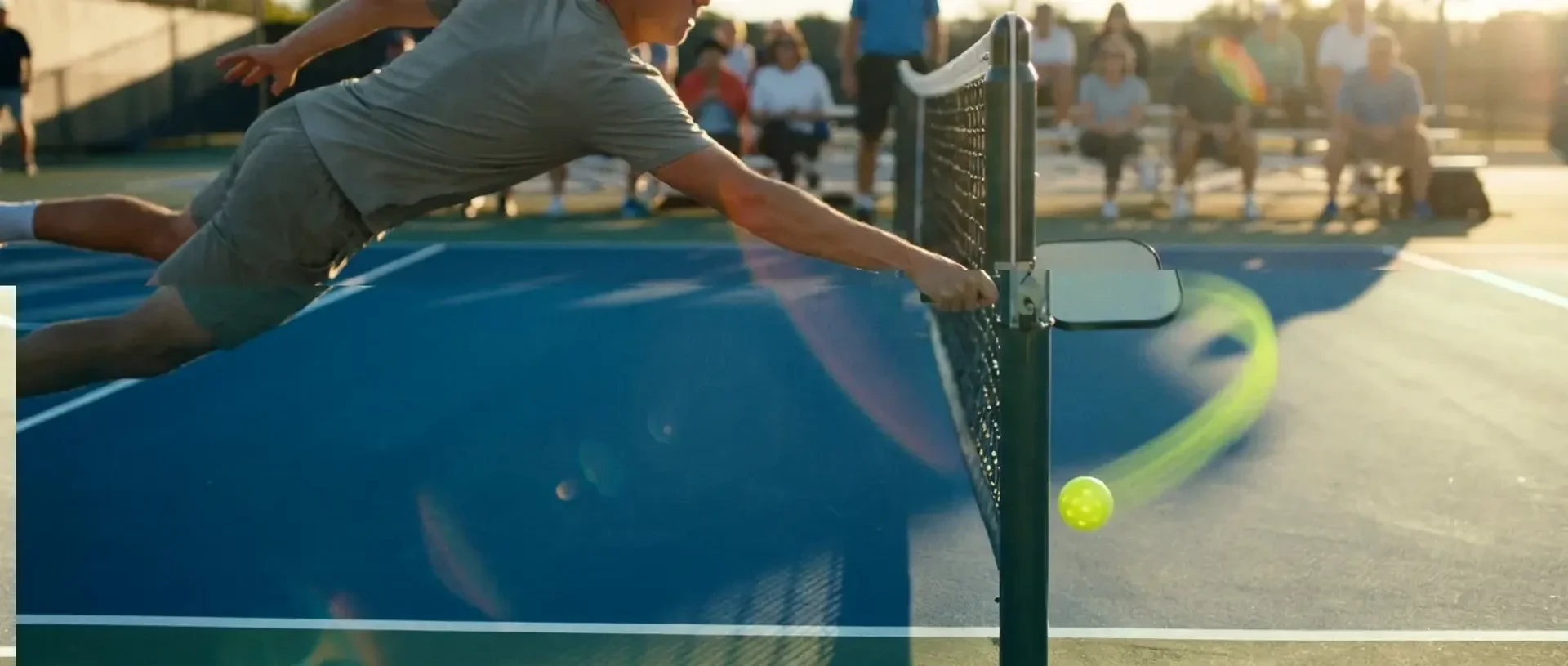
The around-the-post shot, or ATP, is a forehand or backhand groundstroke that travels around the net post instead of over it. It is legal under USA Pickleball rules, which require only that the ball land in bounds in the opponent's court. When the ball is bouncing wide of your sideline, the ATP is often the highest-percentage shot you can hit, not the showy gamble most rec players treat it as.
The geometry that makes it legal
The net is 36 inches at the post and sags to 34 inches at the center. The post sits at the singles sideline. The USA Pickleball rulebook explicitly covers a ball that passes the net post and lands in the opponent's court, and that ball is in.
There is no requirement that the ball travel above the height of the net. The whole point of the ATP is that you are not crossing the net at all. You are going around it.
That changes your target. A flat shot three or four inches off the ground, traveling roughly parallel to the surface, will pass the post if your contact point is outside the sideline and the ball's path angles back into the court. You do not need loft. You do not need spin. You need the right contact point and an angle that keeps the ball inside the opposite singles court.
Three setups that produce ATP opportunities
1. Sharp crosscourt dink that pulls you wide
The textbook setup. Your opponent dinks crosscourt with enough angle that the bounce carries the ball toward the post on your side. You take three or four shuffle steps off the court and intercept the ball at or below knee height after the bounce.
The ball's own momentum is already heading past the sideline, so the lowest, fastest path back into the court is a flat ATP. PPA Tour broadcast analysts often describe this as the "pull-out" pattern, and it is by far the most common ATP look in pro doubles.
You can find broadcast examples through the PPA Tour.
2. A wide-angle dink the opponents miscalculated
A free point if you read it. A 3.5 dinker tries to angle the ball crosscourt and pushes it too wide. The ball is going to bounce inside the kitchen but is heading toward the side wall.
Most players let it go because they think it is sailing out, or they reach with a defensive swing that dies. If you read the bounce early and stay low, you can step around it and put it away.
The opposing team is at the kitchen line expecting either a reach or a let, not an attack.
3. A short-hop reset that lands soft and wide
The rarest pattern, but it shows up against 4.0+ play. The opponent is in the transition zone and lifts a soft reset that lands shallow and wide on your side. The angle opens because the ball is descending toward the sideline rather than your body.
Coaching breakdowns on the Selkirk TV tutorial library cover this pattern, and the cue is the same in every version: the bounce point of the ball is moving toward the post, not toward your body.
If the ball will bounce and stay inside the sideline, it is not an ATP. It is a regular dink.
Common mistakes
Going for the ATP when a kitchen volley is available
This is the costliest error at 3.5 and 4.0. If you can step in and volley the ball out of the air at the kitchen line for a clean angled put-away, do that. The ATP requires letting the ball bounce, resetting your feet, and then swinging. Three more variables than the volley needs. Take the ATP only when the volley is not there, usually because the ball has passed your kitchen line and is dropping low.
Mis-judging the angle
The ATP looks dramatic on YouTube because the ball travels through air outside the sideline. It also fails dramatically when players assume any wide ball is an ATP.
Two angle errors are common: aiming too crosscourt, where the ball goes wide of the far sideline, and aiming too straight, where the ball clips the post or dies in the middle. The reliable target is the inside line of the opposite singles court, not the line you came from.
Straighter is safer than wider.
Swinging too hard
A flat ATP at sixty percent pace lands inside. The same shot at full pace sails by a foot or more. The ATP has no net to absorb errors, so any vertical loft you add becomes distance past the baseline. Keep the swing compact, contact in front, paddle face slightly closed.
Drills
Solo wall drill
Mark a three-foot square on a wall about thirty inches off the ground. Stand eight feet to the side of the wall and drop-feed a ball so it bounces low and wide of your stance. Drive it flat into the square with a compact swing. Thirty reps per side, twice a week. The wall cannot replicate the bounce-off-court geometry, but the drill grooves the contact point and the swing path, which is where most ATP misses come from.
Partner crosscourt feed
Feeder at the kitchen line on side A, you at the kitchen line on side B. The feeder hits sharp crosscourt dinks designed to pull you wide. You let the ball bounce, step around the post, and drive flat into the opposite singles court.
Score ten of fifteen on each side. Then switch and drill the backhand ATP, which is the harder swing and the one most rec players have never tried in practice. If you only ever drill the forehand version, you are leaving half the shot on the table.
The ATP is a percentage shot that looks like a hero shot from the stands. Treat it like a regular tool. Read the bounce, set your feet, swing flat. The ATP stops costing you points and starts winning them.
For a side-by-side of how Briones, CJ Johnson, Tyson McGuffin, and PrimeTime each frame the ATP (the wide-AND-low precondition, the disguise debate, the recovery question, and CJ Johnson's contrarian take on whether to attempt it at 3.0-3.5), see our coach meta-analysis on the ATP shot.
References
- USA Pickleball Official Rulebook 2026 · Section on ball passing the net post
- PPA Tour official site (broadcast and match archive) · Pro-level ATP examples and analyst breakdowns
- Selkirk Sport pickleball education · Coach breakdowns of ATP setups and shot selection
Frequently asked
Tap a question to expand.
Is the ATP shot legal in pickleball?
When should I attempt an ATP versus a regular volley?
Can I hit a backhand ATP?
Why does my ATP keep going wide?
Read next
- Playing Well
Is stacking in pickleball snobby? No. It is optimization. Snobbery is a separate, fixable problem.
- Playing Well
The 4-week third-shot drop drill plan: 12 drills, measurable benchmarks, and the partner pattern that installs the shot for good
- Playing Well
The 4-week pickleball reset drill plan: 12 drills, measurable benchmarks, and the partner pattern that breaks the popup-attack-popup spiral

Reader notes on this guide
Sign in with your email to post. We do not run ad networks; comments are moderated for spam and abuse.
Loading comments...
Sign in to add a comment.